304 North Cardinal

Anti-static Aluminum Foil Bags vs Standard ESD Bags: Which One Do Your Components Actually Need?

Anti-static aluminum foil bags and standard ESD bags are not the same product. They protect electronic components through different mechanisms, perform differently under test conditions, and are appropriate for different applications. Selecting the wrong specification results in component damage that is difficult to trace back to packaging — because ESD damage is often invisible at the point of packaging and only manifests as field failures weeks or months later.
This guide explains the technical differences between anti-static aluminum foil bags and standard ESD bags, defines which specification each component type requires, and provides a decision framework for procurement managers and engineers sourcing ESD packaging across Southeast Asia.
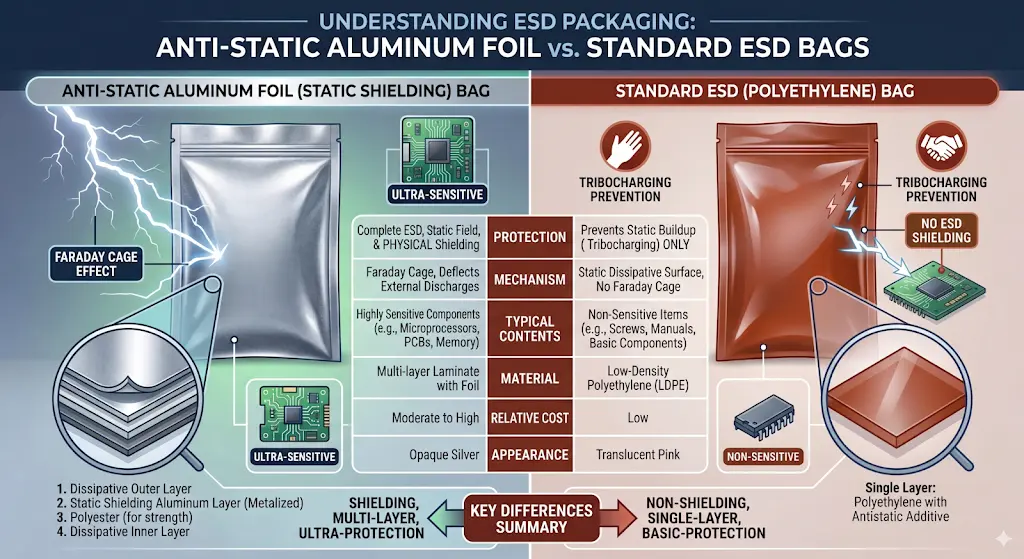
Anti-static Aluminum Foil Bags — The Core Distinction
The electronics packaging industry uses two distinct mechanisms to protect components from electrostatic discharge. Understanding the difference between these mechanisms is the foundation of correct ESD packaging specification.
Static Dissipation
A material is anti-static when it allows electrostatic charge to flow slowly and safely across its surface, preventing charge buildup. Anti-static bags made from pink polyethylene use this mechanism. They prevent the bag itself from accumulating static charge — but they do not shield contents from external electrostatic fields. A component inside a pink anti-static bag is fully exposed to any ESD event occurring in the surrounding environment.
Electrostatic Shielding
A shielding bag creates a Faraday cage — a conductive enclosure that prevents external electric fields from reaching the contents inside. The aluminum foil layer in anti-static aluminum foil bags intercepts external electrostatic energy and routes it around the exterior of the bag. A 1,000 volt ESD pulse applied to the outside of a pink anti-static bag manifests as approximately 800–900 volts inside. The same pulse applied to an aluminum foil shielding bag manifests as less than 20 volts — a reduction of over 97%.
Three Types of ESD Packaging Compared
Type 1: Pink Anti-static Bags (Polyethylene)
Construction: Single-layer LDPE polyethylene with anti-static additives
Protection mechanism: Surface charge dissipation only
ESD shielding: None — no Faraday cage effect
Moisture barrier: None — polyethylene has high MVTR
Correct use: Packaging non-ESD-sensitive items within an ESD Protected Area (EPA) only. Examples: screws, bolts, manuals, documents, non-sensitive mechanical components
Incorrect use: Shipping or storing ESD-sensitive electronic components outside an EPA
Type 2: Metalized Static Shielding Bags (Silver/Grey)
Construction: Multi-layer — outer static dissipative polyester + thin aluminum metallization + inner static dissipative polyethylene
Protection mechanism: Surface dissipation + Faraday cage shielding from thin metallized layer
ESD shielding: Yes — reduces 1,000V pulse to approximately 20V or less
Moisture barrier: Moderate — metallized layer provides some barrier, but MVTR is higher than solid foil
Correct use: Shipping and storing ESD-sensitive components (PCBs, ICs, semiconductors) where moisture barrier performance is not critical, or for short-term storage
Limitation: Metallized layer is fragile — puncture or flexing can crack the metallization and compromise shielding performance
Type 3: Anti-static Aluminum Foil Bags (Silver, Opaque)
Construction: Multi-layer — outer PET film + solid aluminum foil (7–12 microns) + inner anti-static PE
Protection mechanism: Surface dissipation + Faraday cage shielding from solid aluminum foil layer + near-zero moisture barrier
ESD shielding: Yes — solid aluminum foil provides superior shielding performance compared to metallized alternatives
Moisture barrier: Near-zero WVTR — the definitive advantage over Type 2
Correct use: ESD-sensitive components requiring both ESD shielding and moisture protection — the correct specification for most PCBs, ICs, BGAs, and moisture-sensitive devices in Southeast Asia’s high-humidity environment
Which Specification Do Your Components Require?
Use this decision framework:
Your component is a non-ESD-sensitive mechanical part stored within an EPA: → Pink anti-static bag (Type 1) is sufficient
Your component is ESD-sensitive, stored short-term in a humidity-controlled environment: → Metalized static shielding bag (Type 2) is adequate
Your component is ESD-sensitive AND requires moisture protection (MSL 2 and above), OR will be stored or shipped in Southeast Asia’s humid environment: → Anti-static aluminum foil bag (Type 3) is the correct specification
Your component is ESD-sensitive, requires long-term storage of 12+ months, or will be shipped via ocean freight: → Anti-static aluminum foil bag with vacuum seal and desiccant is the correct specification
The Mistake That Costs More Than the Bag
The price difference between a standard pink anti-static bag and an anti-static aluminum foil bag is measured in cents per unit. The cost of an ESD-damaged semiconductor, an MSL exceedance requiring component baking, or a field failure traced to inadequate packaging is measured in multiples of the component value — plus investigation time, rework cost, and customer relationship impact.
In Southeast Asia’s electronics manufacturing environment — where ambient humidity regularly exceeds 80% and ocean freight transit times routinely exceed four weeks — specifying pink anti-static bags for ESD-sensitive components is not a cost-saving decision. It is an underspecification that transfers packaging cost savings into production quality risk.
The correct specification question is not “what is the cheapest anti-static bag?” It is “what level of ESD and moisture protection does this component actually require?”
How to Verify ESD Bag Compliance
Regardless of which bag type you specify, request the following documentation from your supplier before ordering:
For anti-static bags (Type 1):
- Surface resistance test report (should fall in 10⁴ – 10¹¹ ohm range)
For static shielding bags (Type 2 and Type 3):
- Surface resistance test report
- Shielding effectiveness data (energy inside bag should be < 20 nanojoules per IEC 61340-4-8)
- For Type 3: WVTR (Water Vapor Transmission Rate) data
A supplier who cannot provide these documents cannot confirm compliance — regardless of what the product label says.
Can I use a pink anti-static bag to ship a PCB to a customer?
No. Pink anti-static bags provide no shielding against external ESD events — PCBs shipped in pink bags are unprotected from ESD during transit outside an EPA. Use static shielding bags (Type 2) or anti-static aluminum foil bags (Type 3) for shipping ESD-sensitive components.
Are anti-static aluminum foil bags the same as moisture barrier bags?
Anti-static aluminum foil bags and moisture barrier bags (MBBs) are effectively the same product category — both use a solid aluminum foil layer to provide near-zero moisture transmission. The distinction is primarily in terminology: “moisture barrier bag” emphasizes the moisture protection function, while “anti-static aluminum foil bag” emphasizes the ESD shielding function. Both are correct for components requiring both protections simultaneously.
My component datasheet says MSL 1 — do I still need an ESD shielding bag?
MSL classification addresses moisture sensitivity only — not ESD sensitivity. A component can be MSL 1 (not moisture-sensitive) and still be highly ESD-sensitive, requiring static shielding packaging. Check the component datasheet for both MSL classification and ESD sensitivity classification separately.
How do I identify the ESD bag type I currently have?
Pink or blue bags with no metallic layer: Type 1 (anti-static only). Silver/grey translucent bags: Type 2 (metalized shielding). Silver opaque bags that cannot be seen through: Type 3 (aluminum foil composite). If in doubt, request the product datasheet from your supplier.
Mavis manufactures anti-static aluminum foil bags, ESD shielding bags, and moisture barrier packaging for electronics manufacturers across Southeast Asia. Contact us for technical specifications and compliance documentation: mavisv.com/contact