Introduction
The right high temperature tape on a reflow line is invisible — it stays where it was applied, holds its position through the oven, and peels off without residue. The wrong tape is impossible to miss. It curls at the edge, leaves a sticky carbon shadow on the gold finger, or worse, lifts and lands on the next board. For SMT and PCB assembly process engineers, the failure cost is not the cost of the tape; it is the cost of the board it ruined.
This guide walks through the four high temperature tape families used in electronics manufacturing, the specifications that separate process-grade tape from generic “high-temp” labels, and a process-step decision table. For the broader framework on backing, adhesive, and thickness, the industrial tape selection guide is the pillar reference for tape sourcing across all five categories.
Why Temperature Resistance Matters in Electronics Assembly
Lead-free reflow soldering peaks at 245–260°C in the recommended profile, with dwell time above 217°C running typically 60–90 seconds. Wave soldering exposes the underside of the board to a solder bath at 260–270°C for several seconds. Selective soldering localises that exposure but does not reduce the peak. Any tape on or near the board sees the full peak temperature.
Ordinary OPP carton tape softens by 80°C and is molten by 165°C. Standard crepe masking tape begins to scorch at 120°C. Push either of those into a reflow profile and the result is the same: backing carbonisation, adhesive transfer onto the board, and a contamination event that will fail visual inspection at best and short a fine-pitch pad at worst. A high temperature tape is a tape that completes the process step intact — backing, adhesive, and the printed line on the board after peel.
Main Types of High-Temperature Tape
Polyimide (PI / Kapton-style) Tape
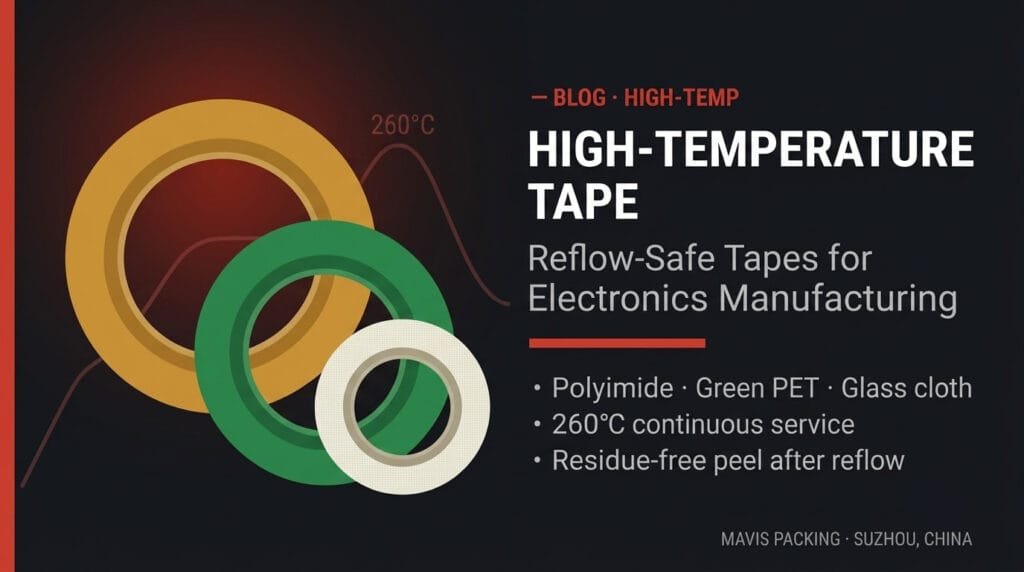
The default reflow-safe tape. A polyimide film backing — typically 25–75 microns thick, amber-translucent — coated with a silicone adhesive. Continuous service temperature 260°C, short-term peak 300°C+, with excellent dielectric strength. Used for gold-finger masking through reflow, wave-solder pallet sealing, board edge masking, and any process where residue-free peel after 260°C exposure is required. Premium polyimide tape leaves no visible adhesive transfer on FR-4, copper, or gold-plated surfaces.
Crepe Masking Tape (Mid-Temperature)
A treated crepe paper backing with rubber or acrylic adhesive, rated to 120–150°C for short exposure. Crepe is not a reflow tape; it is a paint-line and powder-coat tape. Inside electronics manufacturing its place is in enclosure painting, mid-temperature curing of conformal coats, and any masking operation that stays well below the solder profile. Selecting crepe where polyimide is needed is one of the most common and most expensive substitution errors on the assembly floor.
Green PET Polyester Tape
A polyester film backing, distinctively green-tinted, with silicone adhesive. Service temperature roughly 150–200°C continuous, brief peaks higher. Used for PCB plating bath masking (where the green is easy to see in process), wave-solder masking on the underside of through-hole assemblies, and any chemically aggressive masking that would attack a paper backing. Green PET is not a substitute for polyimide on the top side of a reflow line, but it is the right tape for wet processes and selective-solder fixturing where polyimide would be over-specification.
Glass Cloth Tape
Woven glass fibre backing with silicone or PTFE adhesive. Service temperature 200–280°C continuous. Used as heat-sealing-bar wrap on form-fill-seal packaging machines, for high-temperature electrical insulation on transformers and coils, and for masking operations where mechanical abrasion would tear a polyimide film. Glass cloth resists cuts and tears that polyimide cannot, at the cost of being thicker and more difficult to peel cleanly from delicate surfaces.
Key Specifications to Evaluate
Process engineers asked to qualify a new high temperature tape should pull the supplier datasheet and confirm the values below before any line trial. A tape that lacks public data on these points is asking the line to do its qualification work.
- Continuous service temperature. The temperature the tape holds indefinitely without degradation. Critical for masking that stays on the board through multiple thermal cycles.
- Short-term peak temperature. The temperature the tape survives for the duration of one process step. A 260°C reflow peak with 90 seconds above 217°C is a short-term peak event.
- Backing thickness (microns). Determines conformability around edges and pads. Thinner is usually better for masking; thicker improves abrasion resistance.
- Dielectric strength (kV). Critical for insulation applications on transformers, coils, and Li-ion battery cells.
- Residue-free peel rating. A pass/fail on a defined substrate (typically FR-4 or polished steel) after the full process exposure. The number that matters on a reflow line.
- Adhesion to steel. N/cm at standard pull rate. Indicates how aggressively the tape holds during the process step.
- Outgassing. Important for vacuum processes and clean-room applications.
Matching Tape to Process Step
| Process Step | Recommended High Temperature Tape |
|---|---|
| Gold-finger masking through lead-free reflow | Polyimide (PI), 50 micron |
| Wave-solder pallet sealing | Polyimide, 75 micron, or glass cloth |
| Wave-solder masking on the underside of a board | Green PET polyester |
| PCB plating bath masking | Green PET polyester |
| Battery cell tab insulation | Polyimide, 25 micron |
| Transformer and coil high-voltage insulation | Glass cloth or polyimide |
| Heat-sealing bar wrap on packaging machines | Glass cloth with PTFE coating |
| Enclosure painting and powder coat masking (mid-temp) | Crepe masking tape |
| Conformal coat masking (mid-temp cure) | Crepe or Green PET, application-dependent |
For sealing the cartons of finished boards or shipping kits inside an EPA, see the separate guidance on anti-static ESD tape — temperature resistance and ESD safety are independent specifications and the wrong tape can defeat either.
Common Mistakes
- Substituting crepe masking tape for polyimide on the reflow side. The crepe will scorch, lose tack, and transfer adhesive onto the board. This is the single most common reason for “residue” defects traced to tape.
- Confusing continuous and short-term temperature ratings. A tape rated “up to 200°C” may mean continuous service at 200°C, or 30 seconds at 200°C. The two are not interchangeable. Always read the datasheet footnote.
- Ignoring dielectric strength in insulation applications. A high-temp tape that has not been tested for breakdown voltage is unfit for transformer and battery work, regardless of its temperature rating.
- Using polyimide where mechanical abrasion is the real load. PI film tears under repeated rubbing. Glass cloth or PTFE-coated tapes hold up where PI does not.
- Assuming all polyimide tape performs the same. Generic polyimide film with low-grade silicone can leave a haze on the board after reflow even though it survives the temperature. Specify residue-free peel test data on the actual substrate the line uses.
Frequently Asked Questions
What is the maximum temperature for polyimide tape?
Polyimide film with silicone adhesive offers continuous service at 260°C and short-term peak resistance of 300°C or higher, depending on grade. This brackets lead-free reflow and wave-solder profiles comfortably, which is why polyimide is the default reflow-safe tape.
Can I use Green PET instead of polyimide on a reflow line?
No. Green PET polyester is rated 150–200°C continuous, well below a 245–260°C lead-free reflow peak. Use Green PET for PCB plating, wave-solder underside masking, and other wet-process or cooler applications. Use polyimide for reflow.
Why does my high temperature tape leave residue?
Three causes account for most residue complaints. First, the temperature exceeded the tape's short-term peak rating. Second, the adhesive is a generic silicone that softens under prolonged dwell. Third, the tape was left on the board too long after the process step. Specify a tape with documented residue-free peel data on your substrate, and remove tape within the supplier's recommended window.
Is high temperature tape the same as ESD-safe tape?
No. Temperature resistance and ESD dissipation are independent properties. A polyimide tape that survives 260°C is not automatically dissipative; an anti-static ESD tape that holds 109 Ω is not automatically reflow-safe. Each application must be specified against the relevant property; both can be ordered as a single integrated tape only for purpose-built grades.
What is the difference between glass cloth and polyimide tape?
Glass cloth tape uses a woven fibreglass backing with silicone or PTFE adhesive; it is thicker, more abrasion-resistant, and used where mechanical wear is the primary load (heat-seal bars, transformer wrap). Polyimide tape uses a thin film backing; it is more conformable, cleaner on peel, and the standard for fine-pitch PCB masking. Choose by mechanical loading, not by temperature alone.
Conclusion
High temperature tape is one specification, four very different families: polyimide for reflow, Green PET for wet processes and selective-solder masking, glass cloth for insulation and mechanical load, and crepe for genuinely mid-temperature paint and coat masking. The reliable approach is to match tape to process step using documented continuous and short-term ratings, demand residue-free peel data on the actual substrate, and never substitute mid-temperature crepe into a reflow workflow no matter how short the dwell. The yield on the board is worth more than the savings on the roll.
Specification sheets are available on request.
Mavis is a one-stop industrial and electronics packaging supplier based in Suzhou, China, serving distributors and manufacturers across Southeast Asia since 2014. We supply polyimide, Green PET, glass cloth, and crepe high temperature tape grades alongside the rest of our industrial tape catalogue and our full ESD bag and protective packaging range. Contact us for samples, custom specifications, and bulk pricing — 24-hour quote response, flexible MOQ.