Sustainable industrial packaging ASEAN requirements are tightening faster than most manufacturers have planned for — and the transition from voluntary preference to compliance obligation is already underway across Vietnam, Thailand, Malaysia, Singapore, and Indonesia.
The regulatory landscape for industrial packaging across Southeast Asia is changing faster than most manufacturers have adapted to. Extended Producer Responsibility (EPR) frameworks for plastic packaging, mandatory packaging reporting requirements, plastic import bans, and accelerating consumer sustainability expectations are collectively creating an environment where sustainable packaging is transitioning from a voluntary brand preference to a compliance and commercial requirement.
This guide provides a practical summary of where ASEAN’s major manufacturing markets stand on packaging sustainability regulation in 2025, what the requirements mean for industrial packaging specifically, and where paper-based materials such as kraft paper and kraft bubble paper fit in.
Update, October 2026: this guide describes the regulatory picture in 2025, with corrections where timelines have since changed. For what is new this year, see our ASEAN packaging compliance 2026 update.
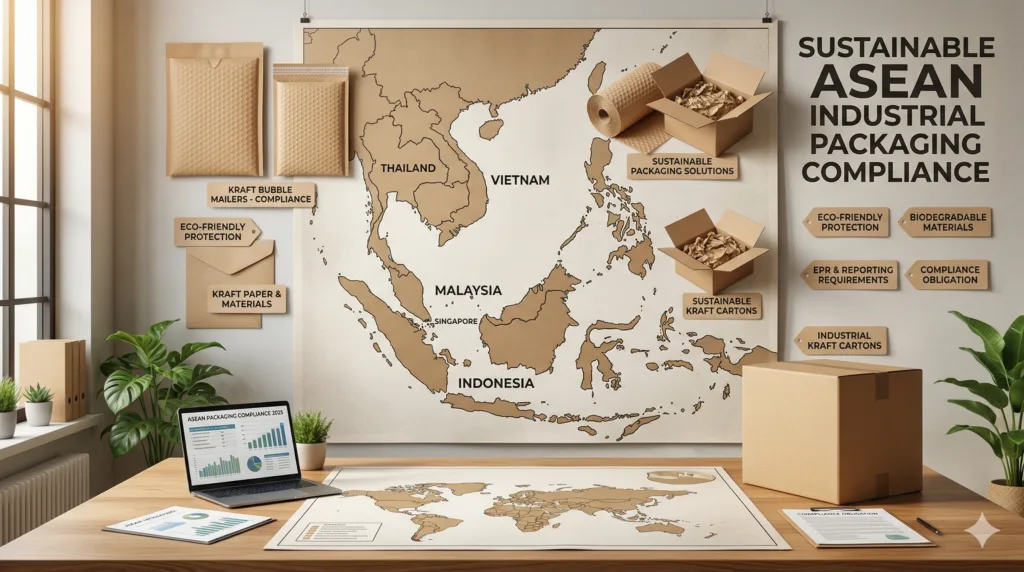
Sustainable Industrial Packaging ASEAN: Regulatory Landscape 2025
Singapore
Singapore has the most developed packaging sustainability framework in ASEAN. Under the Resource Sustainability Act, large businesses — including manufacturers, importers, and retailers — are required to submit annual packaging data reports and 3R (Reduce, Reuse, Recycle) plans. The framework establishes the foundation for an EPR scheme for packaging waste that is advancing toward mandatory producer financial responsibility for packaging end-of-life management.
Singapore also passed the Food Safety and Security Bill in January 2025, extending regulatory oversight of food contact materials — relevant for packaging used in food-adjacent manufacturing.
Vietnam
Vietnam introduced Extended Producer Responsibility under the Law on Environmental Protection (2020) and Decree No. 08/2022/ND-CP. Producers and importers of listed products — including the packaging of goods such as food, cosmetics and medicines — must meet recycling rates or pay into a recycling support fund. Vietnam’s EPR framework is one of the most detailed in ASEAN. (Update 2026: Decree No. 110/2026/ND-CP, in force from 25 May 2026, now sets out these responsibilities and the product list — check it before planning.)
Malaysia
Malaysia’s Plastics Sustainability Roadmap 2021–2030 set voluntary EPR as the framework from 2021–2025, and originally targeted mandatory EPR from 2026. The Circular Economy Blueprint 2025–2035 reinforces this direction. (Update 2026: Malaysia began with a voluntary EPR phase for packaging in 2026; the government has said mandatory compliance for major producers is planned from 2030.)
Thailand
Thailand’s Roadmap on Plastic Waste Management 2018–2030 aims to bring targeted plastic waste back into use — through reuse or recycling — by 2027. Thailand’s ban on plastic scrap imports took effect at the start of 2025, reducing the supply of imported recycled plastic. An EPR framework for packaging is under development.
Indonesia
Indonesia’s Presidential Regulation No. 83/2018 set a target of a 70% reduction in marine plastic debris by 2025, and Ministerial Regulation P.75/2019 requires producers to submit 10-year waste reduction roadmaps aimed at a 30% reduction by 2029. Cities including Jakarta have implemented plastic bag bans, with national single-use plastic restrictions expanding progressively.
What EPR Means for Industrial Manufacturers
EPR frameworks assign financial responsibility for the end-of-life management of packaging to the producers and importers who place that packaging into the market. In practical terms, this means:
Financial contributions to packaging waste collection and recycling systems — calculated based on the weight and type of packaging material used. Plastic packaging typically carries higher contribution rates than paper-based alternatives, reflecting the higher cost of plastic waste management.
Reporting requirements tracking packaging types, volumes, and material composition placed into each market.
Design requirements moving toward recyclable, reusable, or compostable packaging materials — with regulatory penalties or contribution rate premiums for non-compliant packaging.
For industrial manufacturers, this creates a direct financial incentive to reduce plastic packaging volume and transition to paper-based or recyclable alternatives where performance requirements can be met. Where fees are set by material type, moving part of the packaging weight from plastic to paper can lower the fee base — check how each scheme classifies laminated materials such as kraft bubble paper.
How Sustainable Packaging Materials Meet These Requirements
Kraft Paper and Kraft Bubble Paper
Kraft paper is made from wood fiber, and uncoated kraft is generally accepted in paper recycling streams across ASEAN. Paper packaging often carries lower EPR contribution rates than plastic in schemes with material-based rates.
For industrial cushioning and wrapping applications, kraft bubble paper (kraft paper laminated with bubble film) gives comparable cushioning to plastic bubble wrap, because the cushioning comes from the same type of bubble film. The paper outer layer can be recycled with paper once separated from the film; the laminate as a whole is a mixed material.
Implications for Packaging Specification
Prioritize paper-based cushioning where performance requirements allow. For components that do not have sharp edges that require puncture-resistant outer protection, or where ESD protection is provided by primary packaging (aluminum foil bags), kraft bubble paper provides equivalent cushioning performance with better regulatory alignment than plastic bubble wrap.
Use plastic packaging where performance genuinely requires it. Anti-static and ESD shielding packaging for electronic components, moisture barrier bags for moisture-sensitive devices, and vacuum packaging for long-term storage all require plastic or foil laminate materials — paper alternatives cannot replicate these functional properties. EPR schemes generally charge fees on packaging rather than ban technically necessary plastic, although fees may still apply.
Plan for EPR reporting now. Even in markets where mandatory EPR is not yet fully implemented, voluntary reporting and tracking of packaging material volumes and types positions manufacturers for compliance when mandatory frameworks take effect — avoiding the disruption of reactive compliance at implementation.
The Commercial Case Beyond Compliance
Beyond regulatory compliance, sustainable packaging creates commercial advantages that industrial manufacturers in Southeast Asia are increasingly recognizing:
Customer procurement requirements. European and North American buyers are specifying sustainable packaging as a vendor requirement — particularly for components entering EU markets where the Packaging and Packaging Waste Regulation (PPWR) is setting requirements for packaging recyclability, recycled content, and waste minimization. Manufacturers who can demonstrate sustainable packaging practices have a documented advantage in procurement processes for customers with sustainability commitments.
Supply chain differentiation. In commodity manufacturing categories, sustainable packaging is increasingly a differentiating factor that supports higher value positioning and customer retention.
Waste management cost reduction. Reducing plastic packaging volume directly reduces waste management costs — both in the manufacturer’s own operations and through lower EPR financial obligations in markets where contribution rates apply.
Practical Transition Guidance
For industrial manufacturers beginning or accelerating a sustainable packaging transition:
Start with cushioning materials. Plastic bubble wrap is one of the highest-volume, lowest-performance-criticality plastic packaging materials in most industrial operations — and one of the easiest to replace with kraft bubble paper without compromising protection standards.
Maintain plastic where functionally required. ESD packaging, moisture barrier packaging, and other technically specified protective packaging should remain as plastic or foil laminate — these serve critical protection functions that paper alternatives cannot replicate. Expect EPR fees on this packaging, but do not compromise the protection it provides.
Document your packaging inventory. Understanding exactly what packaging materials you use, in what volumes, and for what applications is the prerequisite for both EPR reporting and strategic transition planning.
Engage your packaging supplier. A supplier who understands both the technical performance requirements and the sustainability regulatory context can help you identify transition opportunities that maintain protection standards while improving your packaging sustainability profile.
Do EPR requirements apply to industrial packaging or only consumer packaging?
Scope varies by country. Some schemes cover all packaging placed on the market, while others started with consumer packaging. Vietnam’s EPR rules list the product groups whose packaging is covered (for example food, cosmetics and medicines), so check whether your products are on that list. Manufacturers should review the specific requirements in each market they operate in.
Is kraft paper packaging more expensive than plastic bubble wrap?
Kraft paper cushioning packaging typically carries a modest price premium over all-plastic alternatives. When EPR contribution rates, waste management costs, and customer sustainability requirements are factored in, the total cost differential is frequently smaller than the material price difference suggests — and in some cases, kraft packaging is the better total value proposition.
Can I use kraft bubble paper for all my industrial packaging needs?
No. Kraft bubble paper is appropriate for physical cushioning and wrapping applications where ESD protection and moisture barrier performance are not required (or are provided by separate primary packaging). For ESD-sensitive electronics and moisture-sensitive components, plastic and foil laminate packaging remains the technically correct specification regardless of sustainability preferences.
When do Malaysia’s mandatory EPR requirements take effect?
Malaysia’s packaging EPR started with a voluntary phase in 2026, and the government has said mandatory compliance for major producers is planned from 2030. Manufacturers operating in Malaysia can use the voluntary phase to build their packaging inventory and reporting data.
Where can I find the specific EPR requirements for each ASEAN country?
Each country’s environmental or industry ministry publishes EPR framework documentation. Key references include Vietnam’s Decree No. 08/2022/ND-CP, Singapore’s National Environment Agency packaging reporting guidance, Malaysia’s MAREA (Malaysian Alliance for Responsible Recycling) framework documentation, and Thailand’s Pollution Control Department roadmap publications.
Mavis Packing supplies kraft paper and kraft bubble packaging through our manufacturing partners in China, alongside aluminum foil and ESD bags produced on our own foil-bag line in Suzhou, for manufacturers across Southeast Asia. Specification sheets are available on request. Contact us for specifications: mavisv.com/contact