Kraft bubble bags vs bubble wrap — this comparison matters most for industrial buyers packaging components with sharp edges,shipping internationally, or responding to customer sustainability
requirements across Southeast Asia.
Kraft bubble bags and standard plastic bubble wrap are both cushioning packaging materials. They perform the same fundamental function — absorbing impact energy to protect products during
transit. But their material construction, performancecharacteristics, and appropriate applications differ in ways that matter for industrial buyers making packaging specifications.
This guide provides a direct, practical comparison to help procurement managers and engineers select the correct cushioning material for their specific products, shipping conditions,and sustainability requirements.
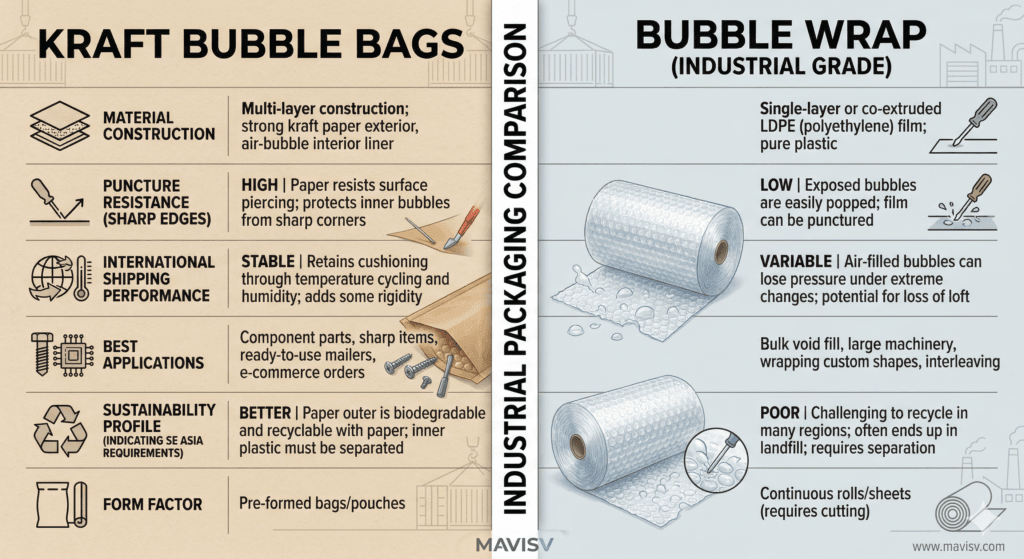
Kraft Bubble Bags vs Bubble Wrap — Material Construction
Standard Plastic Bubble Wrap Manufactured from low-density polyethylene (LDPE), standard bubble wrap is a single-layer plastic film with air-filled cells of various diameters sealed between two film layers. The material is entirely plastic — outer surface, inner surface, and bubble cells are all polyethylene. There is no paper, fiber, or non-plastic component.
Kraft Bubble Bags A laminated composite of two distinct materials: an outer kraft paper layer (typically 60–120 GSM) bonded to an inner polyethylene bubble film layer. The kraft paper provides the structural outer surface; the bubble film provides the cushioning function. These are different materials performing different roles in a single composite product.
This construction difference drives most of the practical performance differences between the two materials.
Performance Comparison: 7 Key Factors
1. Cushioning Performance
Standard Bubble Wrap: Excellent cushioning from air-filled cells. Bubble diameter and film thickness determine the level of impact absorption.
Kraft Bubble Bags: Equivalent cushioning from identical bubble film layer. When the same bubble specification is used, cushioning performance is the same.
Winner: Equal — no meaningful difference when bubble specification is matched.
2. Puncture Resistance
Standard Bubble Wrap: Low puncture resistance. Sharp edges, PCB connectors, metal protrusions, and fasteners puncture bubble wrap during packing or transit — collapsing air cells and eliminating cushioning in the damaged area. This is the most common failure mode of plastic bubble wrap in industrial applications.
Kraft Bubble Bags: High puncture resistance. The kraft paper outer layer absorbs puncture force from sharp component features, protecting the bubble film cushioning layer underneath. Components that reliably puncture standard bubble wrap can typically be packaged in kraft bubble bags without compromising cushioning.
Winner: Kraft bubble bags — significantly superior for components with sharp edges or protrusions.
3. Tear Resistance
Standard Bubble Wrap: Moderate tear resistance. Tears propagate easily once initiated, particularly at bubble cell boundaries.
Kraft Bubble Bags: High tear resistance from the kraft paper outer layer. Kraft paper’s long-fiber construction resists tear propagation, maintaining bag integrity even under rough handling.
Winner: Kraft bubble bags.
4. Surface Protection
Standard Bubble Wrap: The plastic outer surface provides minimal abrasion resistance. In rough handling environments, the outer surface of bubble wrap can abrade against carton interiors, packing tables, and warehouse equipment.
Kraft Bubble Bags: The kraft paper outer surface resists abrasion significantly better than plastic film — maintaining bag integrity through extended warehouse and transit handling.
Winner: Kraft bubble bags.
5. Appearance and Brand Presentation
Standard Bubble Wrap: Clear plastic appearance — functional but associated with disposable plastic packaging in customers’ perceptions.
Kraft Bubble Bags: Natural brown kraft paper appearance signals eco-consciousness and quality. For businesses shipping to customers where unboxing experience matters, the kraft presentation is consistently preferred.
Winner: Kraft bubble bags — for businesses where presentation matters.
6. Environmental Credentials
Standard Bubble Wrap: All-polyethylene construction. Not recyclable through standard curbside programs in most of Southeast Asia — requires drop-off soft plastic recycling, which has limited infrastructure in the region. Contributes to plastic waste streams that are subject to increasing regulatory pressure.
Kraft Bubble Bags: Kraft paper outer layer is recyclable through paper waste streams. The PE bubble film inner layer is recyclable through plastic film programs. Because the paper and film are laminated, they usually need to be separated for recycling — check local acceptance before making recyclability claims to your customers.
Winner: Kraft bubble bags — clear advantage.
7. Cost
Standard Bubble Wrap: Lower material cost per unit area for equivalent cushioning performance.
Kraft Bubble Bags: Modest price premium over standard bubble wrap for equivalent cushioning; the gap depends on specification and volume.
Winner: Standard bubble wrap — on material cost alone. When puncture resistance, tear resistance, and sustainability requirements are factored in, kraft bubble bags are often the better total value.
Decision Matrix: Which to Use for Your Application
| Application | Recommended Material | Reason |
|---|---|---|
| Components with sharp edges or connectors | Kraft bubble bags | Puncture resistance prevents cushioning failure |
| Lightweight consumer goods, e-commerce | Either — kraft preferred | Kraft provides better presentation |
| Heavy industrial components | Kraft bubble bags (thickened) | Superior structural integrity |
| ESD-sensitive electronics | Anti-static bubble (either format) | Standard bubble wrap generates static |
| Long international freight (ocean) | Kraft bubble bags | Better resistance to extended handling |
| Budget-constrained, smooth components | Standard bubble wrap | Lower cost where puncture risk is low |
| Export to EU/US markets | Kraft bubble bags | Customer sustainability requirements |
| Domestic regional shipping, smooth parts | Either — bubble wrap acceptable | Cost optimization possible |
The Case Where Standard Bubble Wrap Remains Appropriate
Standard plastic bubble wrap remains a cost-effective choice for specific scenarios: packaging smooth, rounded products with no sharp protrusions, for short-distance domestic shipping, where customer sustainability requirements are not specified, and where volume is high enough that the cost difference is meaningful to the operation.
Kraft bubble bags do not replace standard bubble wrap in every application. They replace it in applications where puncture resistance, tear resistance, professional appearance, or sustainability requirements are requirements — which describes most industrial and electronics packaging scenarios.
The Case Where Kraft Bubble Bags Are the Clear Specification
Kraft bubble bags are unambiguously the correct specification when:
- The component has sharp edges, PCB connectors, or protruding features that puncture standard bubble wrap
- The shipment destination is a customer with sustainable packaging requirements
- The product is exported to European or North American markets where eco-packaging is expected
- The operation is subject to or anticipating EPR compliance requirements for plastic packaging
- The shipment involves ocean freight with extended handling periods
- Brand presentation at the point of delivery is important to the business
In industrial and electronics manufacturing across Southeast Asia, most packaging decisions satisfy at least one of these criteria — making kraft bubble bags the default-correct specification for the majority of applications.
Can I substitute kraft bubble bags directly for standard bubble wrap without changing my packaging process?
Yes, in most cases. Pre-formed kraft bubble bags use the same loading and sealing process as standard bubble bags. Roll format kraft bubble paper is cut and wrapped in the same way as standard bubble wrap rolls. No process changes are required in most operations.
Do kraft bubble bags provide better protection for PCBs than standard bubble wrap?
Yes. PCB edge connectors reliably puncture standard bubble wrap during loading and transit. The kraft paper outer layer of kraft bubble bags absorbs this puncture force, maintaining cushioning integrity. For PCB packaging, kraft bubble bags are the superior specification.
Are kraft bubble bags available in anti-static versions for ESD-sensitive electronics?
Yes. Kraft bubble bags with anti-static PE bubble film inner layer are available for ESD-sensitive component packaging. For components requiring full ESD shielding, use an aluminum foil shielding bag as primary packaging inside the kraft bubble bag.
What is the minimum order quantity for custom-sized kraft bubble bags?
We support small batch custom orders. Contact us with your required dimensions for a quotation.
Mavis Packing supplies kraft paper bubble bags in standard, thickened, and anti-static specifications through our manufacturing partners in China, for industrial and electronics manufacturers across Southeast Asia. Specification sheets are available on request. Contact us for specifications and pricing: mavisv.com/contact