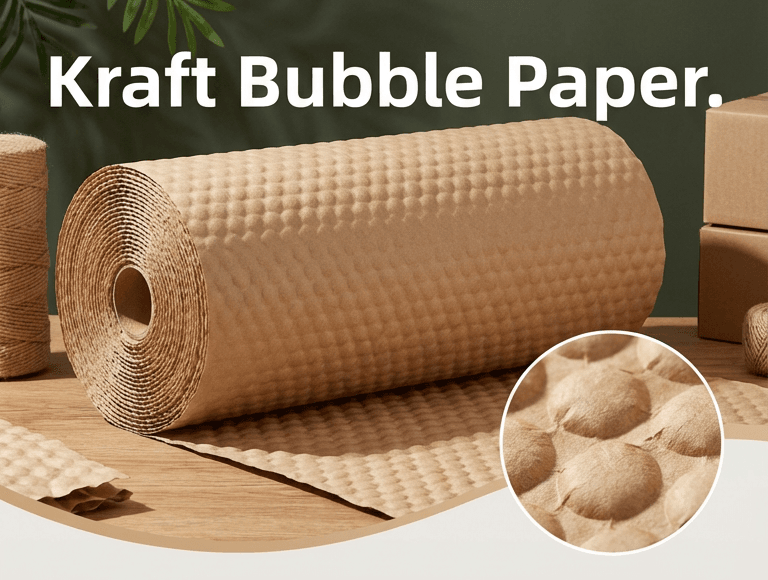
Kraft paper bubble packaging combines bubble-film cushioning with a paper outer layer for industrial and electronics shipping across Southeast Asia.
Kraft paper bubble packaging industrial applications have expanded significantly across Southeast Asia as manufacturers transition away from plastic bubble wrap.
Kraft paper bubble packaging — a laminated material combining a kraft paper outer layer with an air-bubble cushioning structure — has become a practical alternative for manufacturers who need to maintain physical protection standards while transitioning away from all-plastic cushioning materials.
This guide explains what kraft paper bubble packaging is, how its performance compares to standard plastic bubble wrap, and why it is the logical specification choice for industrial manufacturers facing the intersection of cushioning requirements and sustainability pressures in Southeast Asia.
What Is Kraft Paper Bubble Packaging?
Kraft paper bubble packaging is a composite cushioning material that combines two functional layers:
Outer Kraft Paper Layer Natural brown kraft paper, produced by the sulfate pulping process, provides the structural outer surface of the material. Kraft paper’s long-fiber construction gives it higher tensile and tear strength than standard packaging paper — giving the material a robust outer surface that resists puncture from sharp component edges and tearing during rough handling.
Inner Bubble Cushioning Layer An air-filled polyethylene bubble film laminated to the kraft paper inner surface provides the impact absorption function — cushioning packaged items against drops, shocks, and vibration during transit in exactly the same way as standard plastic bubble wrap.
The combination delivers:
- Physical cushioning performance equivalent to standard bubble wrap
- Significantly higher puncture and tear resistance than bubble wrap alone
- A natural, professional paper appearance
- A recyclable outer layer compatible with paper waste streams
Performance Comparison: Kraft Bubble vs Standard Plastic Bubble Wrap
For industrial buyers making the transition, the first question is whether kraft bubble packaging provides equivalent or better physical protection.
Cushioning Performance The air-bubble cushioning layer in kraft bubble packaging functions identically to standard bubble wrap — air-filled cells absorb and dissipate impact energy during drops and transit shocks. When identical bubble diameter and film thickness are specified, cushioning performance between kraft bubble and plain bubble wrap is equivalent. Kraft bubble bags are available in standard bubble (10mm diameter) and large bubble (28mm diameter) specifications to match product weight and fragility.
Puncture and Tear Resistance This is where kraft bubble packaging is meaningfully superior to standard bubble wrap. The kraft paper outer layer absorbs puncture force that would pop bubble wrap — maintaining cushioning integrity when packaging components with sharp edges, PCB connectors, or protruding fasteners that would puncture standard plastic bubble wrap, collapsing the air cells and eliminating cushioning.
Surface Protection The kraft paper surface provides abrasion resistance that the outer face of standard bubble wrap cannot match — protecting the bag surface from tearing against rough carton interiors, sharp packing edges, and warehouse handling equipment.
Weight Kraft bubble packaging adds minimal weight compared to standard bubble wrap of equivalent cushioning specification. For high-volume operations, the weight difference is negligible from a logistics cost perspective.
Applications in Industrial and Electronics Packaging
Electronics Component Shipping PCBs, sensors, display modules, and electronic assemblies benefit from the combination of ESD-safe inner bubble cushioning (specify anti-static bubble variants for ESD-sensitive items) and the puncture resistance of the kraft paper outer layer. Components with sharp board edges or protruding connectors that puncture standard bubble bags can be reliably packaged in kraft bubble bags.
Industrial Component Protection Precision-machined metal components, optical instruments, measurement equipment, and mechanical assemblies require packaging that protects against transit impacts without being punctured by the component itself. Kraft bubble bags provide the necessary combination of cushioning and structural integrity.
E-commerce Fulfillment For manufacturers shipping directly to customers across Southeast Asia or internationally, kraft bubble bags give a professional, paper-based presentation at the point of delivery.
Export Packaging For components and products shipped to European and North American markets — where customer sustainability requirements and eco-packaging preferences are increasingly specified in purchasing contracts — kraft bubble bags provide compliant cushioning packaging that meets both performance and environmental criteria.
Why the Transition Is Happening Now
Across Southeast Asia, three converging factors are accelerating the transition from plastic bubble wrap to kraft bubble packaging:
Regulatory Pressure Extended Producer Responsibility (EPR) frameworks for plastic packaging are being implemented across the ASEAN region. Indonesia, Vietnam, Singapore, Thailand, and Malaysia all have active or developing EPR frameworks that make plastic packaging more costly to produce and manage. Businesses using plastic packaging will face increasing compliance costs as these frameworks mature.
Customer Requirements European and North American buyers are increasingly including sustainable packaging specifications in their vendor requirements — particularly for components shipped into EU markets where the Packaging and Packaging Waste Regulation (PPWR) is setting new standards for recyclable and bio-based packaging materials. A paper outer layer can support these requirements, provided the full material construction is documented.
Total Cost Reality When businesses account for waste management costs, potential future EPR compliance fees, and the growing premium customers are willing to pay for sustainable packaging, the cost differential between kraft bubble and plastic bubble wrap narrows significantly. For businesses whose customers explicitly value sustainable packaging, kraft bubble packaging can be a differentiating factor rather than merely an additional cost.
Selecting the Right Kraft Bubble Specification
Standard vs Thickened Construction Standard kraft bubble bags (60–80 GSM kraft paper, standard bubble film) are appropriate for lighter components and short-distance regional shipping. Thickened kraft bubble bags (100–120 GSM kraft paper, heavier bubble film) are specified for heavier components, sharp-edged items, and international freight where the package will undergo extended handling.
Bubble Diameter 10mm diameter bubbles provide effective cushioning for lighter, less fragile items. 28mm diameter bubbles provide greater impact absorption for heavier components and applications where significant drop height is a risk factor.
Bag vs Roll Format Pre-formed bags are efficient for high-volume operations packing similar-sized products. Roll format (kraft bubble paper) provides flexibility for operations packing varied product sizes — the material is cut to length and wrapped around the product.
Closure Type Heat-seal open-end bags require a heat sealer on the packing line. Self-seal adhesive strip bags provide faster packaging without equipment. Open-end bags for manual sealing with tape are the most economical option for low-volume operations.
Is kraft paper bubble packaging as protective as standard plastic bubble wrap?
Yes. When equivalent bubble diameter and film thickness are specified, cushioning performance is equivalent. Kraft bubble packaging is additionally more puncture-resistant due to the kraft paper outer layer — making it superior to standard bubble wrap for components with sharp edges.
Can kraft bubble packaging be recycled?
The kraft paper outer layer is recyclable through standard paper recycling streams. The inner polyethylene bubble film is recyclable through plastic film recycling programs. In most Southeast Asian markets, the kraft paper component can be separated and recycled through existing paper waste infrastructure.
Is kraft bubble packaging more expensive than standard plastic bubble wrap?
Kraft bubble packaging typically carries a modest price premium over standard plastic bubble wrap. When accounting for superior puncture resistance, professional appearance, and alignment with sustainability requirements from customers and regulators, the total value proposition is increasingly favorable.
Can I use kraft bubble packaging for ESD-sensitive electronics?
Standard kraft bubble bags do not provide ESD protection — the bubble film is standard polyethylene. For ESD-sensitive components, specify kraft bubble bags with anti-static bubble film inner layer, or use separate ESD-protective primary packaging (aluminum foil shielding bag) inside the kraft bubble bag for dual protection.
What sizes and formats are available?
Kraft bubble packaging is available in pre-formed bags (all custom dimensions), flat bags, and roll format. Custom sizes are manufactured to your exact specifications. Small batch orders are welcome.
Mavis Packing supplies kraft paper bubble bags and thickened kraft bubble bags through our manufacturing partners in China, for manufacturers across Southeast Asia. Specification sheets are available on request. Contact us for specifications and custom sizing: mavisv.com/contact