Ordering custom non-woven bags for the first time — or switching to a new supplier — is straightforward when you know what specifications to provide. Most ordering problems, production delays, and quality disputes in custom non-woven bag procurement trace back to the same root cause: the buyer did not provide complete technical specifications, and the manufacturer filled in the gaps with whatever was cheapest or most convenient.
This guide walks through every specification decision required to order custom non-woven bags correctly — from GSM selection to size determination to printing method — so that what arrives is exactly what was intended.
Custom Non-woven Bags Manufacturer: Define Application First
Before specifying any material parameter, define exactly what the bag needs to do:
- What will be placed inside it? (Weight, dimensions, sharp edges?)
- How many times will it be used? (Single use, 10 uses, 100+ uses?)
- Where will it be used? (Clean warehouse, outdoor event, retail store?)
- Does it need to carry a printed logo or design?
- Does it need water resistance?
- What sustainability requirements apply?
Answering these questions before opening a specification form prevents the most common ordering mistake: specifying a bag that is either over-engineered (and more expensive than needed) or under-engineered (and fails in service).
Step 2: Select the Right GSM
GSM (grams per square meter) is the single most important specification. It determines the bag’s strength, durability, feel, and cost — and it is the specification most commonly under-specified or substituted by manufacturers.
GSM Selection Guide:
| Use Case | Recommended GSM |
|---|---|
| Single-use promotional giveaway | 60–75 GSM |
| Retail product bag, light use | 75–90 GSM |
| General packaging, moderate reuse | 90–100 GSM |
| Industrial component packaging | 100–120 GSM |
| Heavy-duty repeated industrial use | 120+ GSM |
| Branded corporate gift / premium retail | 100–120 GSM (laminated) |
Critical rule: Always specify GSM as a minimum in your purchase order — not just a nominal value. Write “minimum 100 GSM” not “100 GSM.” Manufacturers who cut corners substitute lower GSM material because the difference is invisible until the bag fails in use. A minimum specification requirement gives you contractual basis to reject non-conforming product.
Step 3: Choose the Material Construction
Unlaminated PP Spunbond
The standard construction — natural non-woven surface texture, good for screen printing, breathable, lowest cost. Correct for most industrial and promotional applications.
BOPP Laminated
A smooth, glossy film surface laminated over the non-woven base — provides water resistance, easier cleaning, and significantly better print quality for complex multi-color or photographic designs. Specify for premium retail, branded corporate packaging, and applications requiring water resistance.
Matte Laminated
Same as BOPP laminated but with a matte surface finish — preferred for a more understated, premium appearance. Popular for luxury retail and professional B2B applications.
Recycled Content
Specify if recycled content is required. Recycled PP non-woven is available from some material suppliers; we confirm availability, the recycled share and supporting documents with the quotation.
Step 4: Determine the Correct Size
Non-woven drawstring bags are custom manufactured — all dimensions are made to order. There is no “standard” size that manufacturers stock. To specify dimensions correctly:
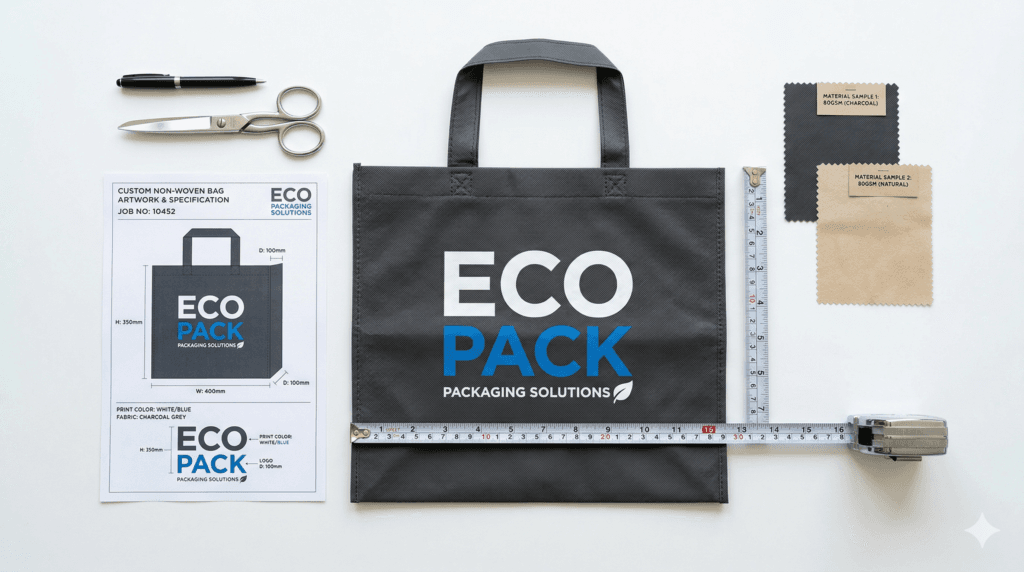
Measure your product — not the bag Measure the actual product or component that will go inside the bag. Add clearance on each dimension for loading and removal — typically 20–30mm per side for easy loading without forcing. For products with irregular shapes, measure the widest point in each dimension.
Account for drawstring closure volume A drawstring bag’s usable depth is typically 30–50mm less than the total bag height — the top portion is taken up by the hem and drawstring. If your product is 250mm tall, specify a bag height of at least 300–310mm to ensure the contents fit below the drawstring closure.
Specify as: Width × Height (× Gusset depth if applicable) Example: “350mm × 420mm, no gusset” or “280mm × 350mm × 80mm gusset”
Step 5: Select the Printing Method
Screen Printing — the default choice for most orders
Screen printing is the correct method for the majority of custom non-woven bag orders: logos, text, simple graphics, 1–4 colors. It produces durable, high-saturation prints that maintain quality through repeated use and cleaning. Setup requires a separate screen per color — this generates a one-time setup cost that is amortized across the order quantity, making screen printing more cost-effective as the order quantity grows.
What to provide: Vector artwork file (AI or EPS format), Pantone color codes for each print color, print dimensions (width × height of printed area), print location on bag (front, back, both).
Heat Transfer — for full-color complex designs
Heat transfer is the correct method when your design includes photographic imagery, complex gradients, or more than 4 colors. A full-color digital print is made on transfer paper and heat-pressed onto the bag surface. Higher per-unit cost than screen printing, but no color-based setup cost and lower minimum quantities.
Digital Printing — for samples and very short runs
Direct digital printing onto non-woven fabric. No minimum quantity, no setup cost — suitable for prototypes, samples, and very small orders. Not recommended for the final production order if screen printing is viable at the intended volume.
Step 6: Specify Drawstring and Construction Details
Drawstring material: Polyester cord (recommended for industrial and repeated-use) or PP cord (lower cost, lower strength — acceptable for light promotional use).
Drawstring color: Match to bag color, contrast color, or brand color. Specify Pantone code if exact color matching is required.
Seam construction: Standard overlocked seam (general use) or reinforced double-stitched seam (heavy industrial use, loads over 3kg, high-frequency reuse).
Bottom construction: Flat bottom (standard) or gusseted bottom (for bulkier contents or self-standing requirement).
Closure: Standard drawstring (default). With cord lock (for applications requiring secure hold without retying). With reinforced grommets (for heavy loads).
Step 7: Request a Pre-production Sample
For any new custom bag order — regardless of supplier experience — always request a pre-production sample before committing to full production quantity. The sample allows verification of:
- Actual GSM vs specified (weigh the sample and calculate)
- Print color accuracy vs Pantone reference
- Seam integrity under intended load
- Drawstring operation and cord quality
- Dimensional accuracy vs specification
Approving a pre-production sample creates a physical quality standard that the production run must match — and provides a clear reference point if quality disputes arise.
Common Specification Mistakes to Avoid
Specifying GSM without a minimum guarantee The most expensive mistake. Write “minimum 100 GSM” in your purchase order.
Providing raster artwork instead of vector Raster images (JPEG, PNG) cannot be scaled without quality loss. Always provide vector artwork (AI, EPS, or PDF with embedded fonts) for screen printing.
Not specifying Pantone colors “Red” means something different to every manufacturer. Specify Pantone Matching System (PMS) codes for every print color to ensure accurate reproduction.
Ordering the minimum quantity to save cost Non-woven bags have significant per-unit cost reduction between minimum quantities and larger runs. Get a tiered price quote (MOQ, 2× MOQ, 5× MOQ) before committing — the volume discount often makes a larger order the better economic decision.
Not accounting for drawstring area in height specification Always add 50mm to your required product depth when specifying total bag height to account for the drawstring closure area.
Complete Specification Summary Template
When placing a custom non-woven bag order, provide the following:
Material: PP spunbond / BOPP laminated / matte laminated / recycled content
GSM: [value] minimum
Dimensions: [W]mm × [H]mm × [Gusset]mm (if applicable)
Drawstring: Polyester / PP, color: [Pantone code or description]
Seam: Standard overlocked / reinforced double-stitched
Bottom: Flat / gusseted
Closure: Standard drawstring / cord lock / reinforced grommets
Print method: Screen printing / heat transfer / digital
Print colors: [list all Pantone codes]
Print location: Front only / back only / both sides
Print dimensions: [W]mm × [H]mm
Artwork file: AI / EPS / PDF (vector)
Quantity: [units]
Sample required before production: Yes / No
Providing complete specifications upfront eliminates the most common sources of production delays, quality disputes, and reorder costs.
What is the minimum order quantity for custom non-woven drawstring bags?
Minimum order quantities vary by construction and printing method. We support small batch orders — contact us with your full specification for a quotation including tiered pricing at different quantities.
How long does production take?
Lead time depends on quantity, printing method and the production schedule; we confirm it with the quotation, counted from artwork approval and order confirmation. If you have a fixed deadline, tell us at inquiry.
Can I order bags in multiple sizes in a single order?
Yes. Multiple sizes and designs can be included in a single order. Each size and print design is quoted separately.
Do you provide artwork assistance if I only have a logo file?
Yes. Our team can adapt your logo and brand assets into a print-ready layout. Provide your logo file (ideally vector format), brand color codes, and any text to be printed, and we will prepare the artwork for your review.
Can recycled content be certified?
Recycled-content claims need third-party certification, such as GRS (Global Recycled Standard), held by the material supplier. If your program requires certified recycled content, specify it at inquiry and we will check availability for your order.
Contact Mavis for custom non-woven bag specifications, samples, and pricing: mavisv.com/contact