Non-woven drawstring bags occupy a specific and useful position in industrial packaging — reusable, lightweight, customizable, and cost-effective at volume. They are used across a wider range of applications than most buyers initially consider: from component containment and kitting in electronics manufacturing, to branded distribution bags for industrial product lines, to protective storage for finished goods awaiting shipment.
This guide covers the technical specifications that determine performance — GSM, material type, construction, and closure — as well as printing options and applications, to help industrial buyers specify the correct non-woven drawstring bag for their application.
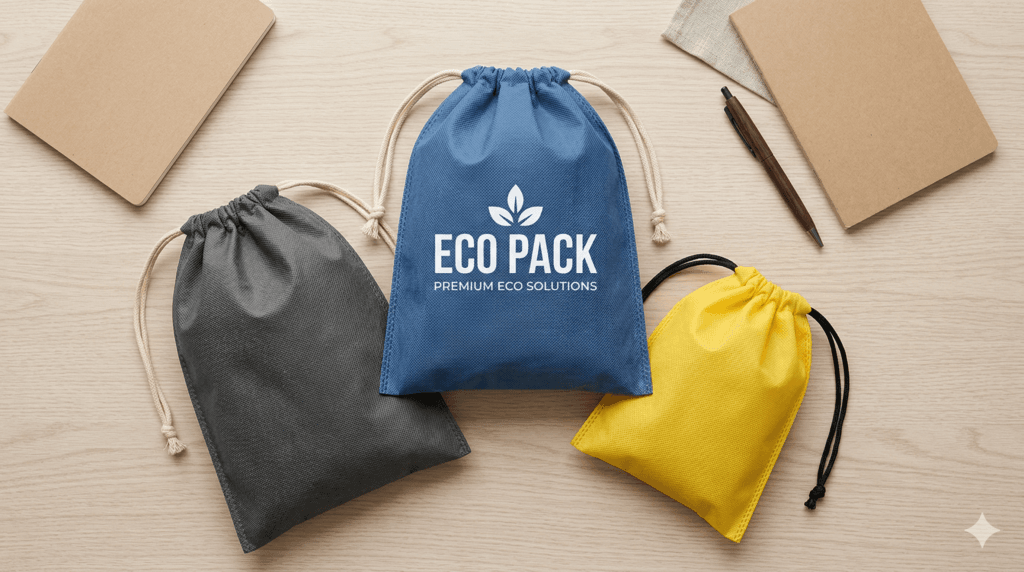
Non-woven Drawstring Bags Industrial: What They Are
A non-woven drawstring bag is a bag manufactured from non-woven polypropylene (PP) fabric — a material produced by bonding synthetic fibers together through heat, pressure, or chemical processes, rather than by weaving or knitting. The result is a fabric-like sheet material with consistent strength across all directions, a smooth printable surface, and significant flexibility in weight (GSM) and construction.
The drawstring closure — typically polyester or PP cord threaded through a hem at the bag opening — provides quick, secure, and re-openable closure without requiring heat sealers, clips, or fasteners. The bag can be opened and resealed repeatedly, making it suitable for applications requiring repeated access to bag contents.
The Most Important Specification: GSM
GSM (grams per square meter) is the fundamental specification for non-woven bags — it determines fabric weight, thickness, strength, load capacity, and print quality. Every other specification is secondary to getting GSM right for the application.
60–80 GSM — Lightweight
Thin, flexible, low-cost material. Suitable for lightweight promotional giveaways, single-use event bags, and light product packaging where long-term reuse is not expected. Print quality is acceptable but less crisp than higher GSM. Not recommended for repeated heavy use or load-bearing industrial applications.
80–100 GSM — Standard
The most widely used range for retail, promotional, and general packaging applications. Good balance of strength, flexibility, and cost. Suitable for most component packaging, light industrial use, retail product bags, and corporate giveaways. Screen printing quality is good in this range.
100–120 GSM — Heavy Duty
Thick, structured material with significantly higher load capacity and tear resistance than standard weight. Suitable for packaging heavier components, repeated-use industrial applications, and applications where the bag must maintain its shape under load. Provides the best print quality for multi-color designs.
120+ GSM — Industrial Grade
Maximum durability for demanding industrial applications — carrying tools, hardware, or heavy equipment. Higher material cost but provides the longest service life for high-frequency reuse applications.
Material Types
Standard PP Spunbond Non-woven
The most common material — polypropylene fibers bonded by heat and pressure. Good strength, consistent surface texture, and well-suited to single-color and multi-color screen printing. The slightly fibrous texture is the baseline appearance for non-woven bags.
BOPP Laminated Non-woven
A thin BOPP (biaxially oriented polypropylene) film is laminated to the surface of the non-woven base fabric. The laminated surface is smoother and glossier — providing better water resistance, easier surface cleaning, and higher print quality for photographic or complex multi-color designs. Laminated bags are slightly stiffer and less breathable than unlaminated. Preferred for premium retail applications and branded corporate packaging.
PET Spunbond Non-woven
Polyethylene terephthalate fiber non-woven provides higher heat resistance and slightly sharper printing results than PP spunbond. Used in applications where higher temperature resistance is required or where print definition is a priority.
Recycled PP Non-woven
Non-woven fabric that includes post-industrial recycled polypropylene. The recycled share and performance vary by material supplier, so ask for documentation of the recycled content — relevant for operations subject to EPR frameworks or customer sustainability requirements.
Construction Details That Matter
Seam Construction
Standard non-woven bags use overlocked or heat-sealed seams. For heavy-duty industrial applications, reinforced double-stitched seams significantly increase load capacity and service life. Specify reinforced seams when bags will carry loads exceeding 3–5 kg or will be used repeatedly over extended periods.
Bottom Construction
Flat-bottom construction provides stable standing and maximum volume utilization for bulky components. Gusseted bottoms expand to accommodate thicker items. For very heavy loads, laminated or layered bottom panels provide additional puncture resistance at the base.
Drawstring Material and Quality
Polyester drawstrings have higher tensile strength and better abrasion resistance than PP cord — important for high-frequency use where the drawstring is the component most likely to fail. Specify polyester drawstring for industrial and repeated-use applications.
Handle Reinforcement
For bags that will be carried with heavy contents, reinforced eyelet grommets at the drawstring entry points prevent the cord from tearing through the fabric under load.
Printing Options
Non-woven bags offer four standard printing methods, each with different cost, quality, and volume implications:
Screen Printing Best for: 1–4 color designs, logos, simple graphics, high volume Quality: Good color saturation and durability Minimum volume: Medium to high; confirmed at quotation Cost: Low per-unit at volume; setup cost for each color screen
Heat Transfer Printing Best for: Full-color photographic designs, complex gradients Quality: High definition, full color range Minimum volume: Lower minimums than screen printing Cost: Higher per-unit than screen printing; no screen setup cost
Digital Printing Best for: Very short runs, variable data, prototypes Quality: Good for simple designs; less color saturation than screen printing Minimum volume: No minimum Cost: Highest per-unit cost; no setup cost
Flexographic Printing Best for: Single-color or two-color designs at very high volume Quality: Consistent and fast Minimum volume: High Cost: Lowest per-unit at very high volumes
For most industrial and B2B packaging applications, screen printing on 90–120 GSM material provides the best combination of print quality, durability, and cost.
Industrial and Electronics Applications
Component Kitting and Assembly Packaging
Non-woven drawstring bags are used in electronics and industrial assembly operations to contain component kits — groups of parts required for a single assembly operation, pre-packaged to simplify line-side presentation and reduce picking errors. The re-openable drawstring allows repeated access during assembly.
Finished Product Protective Storage
Electronics assemblies, instruments, and precision tools awaiting shipment or storage are placed in non-woven drawstring bags to protect against dust accumulation and light surface contact damage during warehouse storage periods.
Branded Distribution Packaging
For manufacturers distributing products through distributors or dealers across Southeast Asia, branded non-woven drawstring bags serve as both outer packaging and a brand communication vehicle — the bag remains in use after the product is removed, extending brand presence beyond the initial transaction.
Trade Show and Corporate Giveaway
Electronics manufacturers, industrial suppliers, and B2B service providers use custom-printed non-woven drawstring bags as promotional items and trade show bags — providing a useful, branded item that reinforces brand awareness with procurement managers and engineers who are the target audience.
Retail Product Packaging
For consumer-facing product lines — accessories, tools, small appliances — non-woven drawstring bags provide reusable retail packaging that customers value and retain, extending the packaging’s useful life beyond a single transaction.
What GSM should I specify for packaging electronic assemblies?
For most electronics component kitting and assembly packaging, 90–100 GSM provides the right balance of structure and flexibility. For heavier assemblies or repeated industrial use, specify 100–120 GSM with reinforced seams.
Are non-woven bags eco-friendly?
Non-woven polypropylene bags are reusable, so the more times a bag is reused, the lower its material use per trip compared with single-use bags. PP non-woven is technically recyclable, though infrastructure varies across Southeast Asian markets. If recycled content matters to your customers, specify it at inquiry and ask for supporting documentation.
Can non-woven drawstring bags be washed?
Unlaminated non-woven bags can be spot-cleaned with mild soap and cool water — avoid hot water and machine drying. Laminated non-woven bags can be wiped clean with a damp cloth.
What is the typical minimum order quantity for custom-printed non-woven drawstring bags?
Minimum order quantities vary by printing method and customization level. We support small batch orders — contact us with your requirements for a specific quotation.
What sizes are available?
All dimensions are custom manufactured. Contact us with your required dimensions, GSM, and printing specifications.
Contact Mavis for non-woven drawstring bag specifications and custom orders: mavisv.com/contact