Both glassine bags and kraft paper bags are paper-based packaging. Uncoated versions of both generally go into paper recycling streams. At a superficial level, they appear interchangeable — both are paper bags for protecting products.
In practice, they are manufactured differently, perform differently, and are designed for different applications. Choosing the wrong one for a given application either results in product damage (using rough kraft paper where glassine’s smooth surface was required) or unnecessary cost (using premium glassine where standard kraft paper strength was the only requirement).
This guide provides a direct comparison across the properties that matter for industrial and electronics packaging buyers making this specification decision.
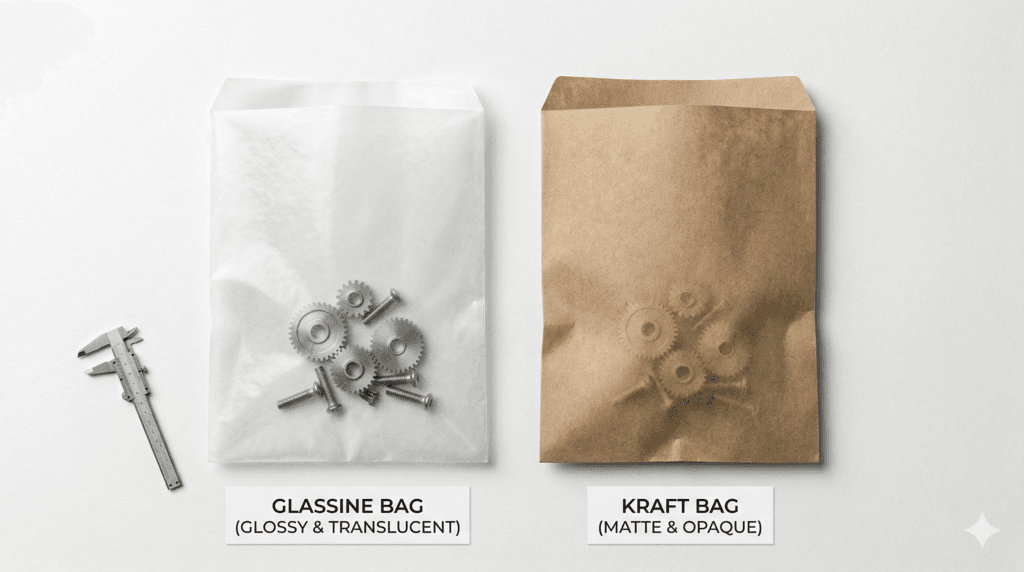
Glassine Bags vs Kraft Paper Bags: Material Construction
Kraft Paper Bags
Kraft paper is produced by the sulfate chemical pulping process, which retains the long cellulose fiber structure that gives kraft its strength. The paper has a characteristically rough, fibrous surface — high tensile and tear strength is its primary design objective. Kraft paper is optimized for mechanical performance: holding weight, resisting tearing, and withstanding rough handling.
Glassine Bags
Glassine is produced from highly refined pulp processed through supercalendering — heated rollers compress the fiber structure to maximum density, creating a smooth, glossy, semi-transparent surface. Glassine is optimized for surface properties: non-abrasive contact, grease resistance, acid-free composition, and semi-transparency. Mechanical strength is secondary to surface quality.
This manufacturing difference drives every practical difference between the two materials.
Direct Comparison: 8 Key Properties
1. Surface Smoothness and Abrasion
Kraft Paper Bags: Fibrous, rough surface. Will leave fiber marks and light scratches on polished metal surfaces, optical components, and precision electronics surfaces on contact. Not suitable where surface contamination is a quality concern.
Glassine Bags: Ultra-smooth, calendered surface. Will not scratch, mark, or leave fiber residue on polished metals, optical surfaces, or precision components. The correct choice wherever the packaging must not contaminate the packaged item’s surface.
Verdict: Glassine for surface-sensitive applications. Kraft for applications where surface contact quality is not a concern.
2. Tensile and Tear Strength
Kraft Paper Bags: High tensile and tear strength from long-fiber construction — kraft paper is 2–3 times stronger than standard paper. Resists tearing under load and rough handling. Can carry significantly heavier products without bag failure.
Glassine Bags: Moderate strength — adequate for light to medium loads, but lower tensile and tear strength than equivalent weight kraft paper. The supercalendering process that creates glassine’s smooth surface compresses fiber structure in a way that reduces tear resistance compared to kraft.
Verdict: Kraft for heavy components, sharp-edged products, and applications where bag failure under load is a risk. Glassine for lighter products where load-bearing capacity is not the primary requirement.
3. Transparency and Visibility
Kraft Paper Bags: Opaque — contents cannot be seen without opening the bag. Requires labeling or coding to identify contents externally.
Glassine Bags: Semi-transparent — contents can be partially identified through the bag without opening, simplifying incoming inspection, inventory management, and retail display.
Verdict: Glassine when visibility is important. Kraft when opacity is preferred or irrelevant.
4. Grease and Oil Resistance
Kraft Paper Bags: Limited grease resistance — oils and greases will penetrate standard kraft paper over time, potentially contaminating the bag exterior or causing bag failure in applications involving oily components.
Glassine Bags: Good grease and oil resistance from the dense fiber structure — glassine resists grease penetration significantly better than kraft paper without any coating additive.
Verdict: Glassine for applications involving oily components or greasy environments. Kraft for dry component applications.
5. Acid-Free Composition
Kraft Paper Bags: Standard kraft paper has mildly acidic characteristics (pH typically 5–7) due to residual lignin and pulping chemistry. For long-term storage of sensitive components, mild acid migration from kraft paper can affect surface quality over months to years.
Glassine Bags: Inherently acid-free (pH 7–9) due to the refined pulp and supercalendering process. Safe for long-term contact with photographic media, precision optics, archival documents, and sensitive components where acid migration is a concern.
Verdict: Glassine for long-term archival storage and surface-sensitive components. Kraft acceptable for short-term packaging where acid migration is not a concern.
6. Static Generation
Kraft Paper Bags: Standard kraft paper generates moderate triboelectric static on contact with packaging surfaces and other materials during handling.
Glassine Bags: Glassine has low triboelectric generation — it does not build up static charge readily on contact. For lower-sensitivity electronics where full ESD shielding is not required but static generation should be minimized, glassine bags provide a passive benefit.
Verdict: Glassine has a modest advantage for electronics applications where static generation should be minimized. Neither is a substitute for dedicated ESD packaging for sensitive components.
7. Moisture Barrier
Kraft Paper Bags: Limited moisture resistance — standard kraft paper absorbs atmospheric moisture and provides no meaningful barrier to moisture vapor transmission.
Glassine Bags: Light moisture resistance from the dense surface — resists surface moisture and light humidity better than kraft paper. However, glassine is not waterproof and does not provide a full moisture barrier.
Verdict: Neither is suitable for applications requiring full moisture barrier protection — specify aluminum foil composite bags for moisture-sensitive components. Glassine has a marginal advantage for light humidity exposure.
8. Cost
Kraft Paper Bags: Lower material cost — kraft paper is produced in very high volumes globally and is one of the most cost-effective packaging papers available.
Glassine Bags: Higher material cost — the supercalendering process and refined pulp requirement make glassine more expensive than equivalent weight kraft paper.
Verdict: Kraft for cost-sensitive, high-volume applications. Glassine where the surface and compositional properties justify the premium.
Application Decision Guide
| Application | Recommended Bag | Reason |
|---|---|---|
| Polished metal parts interleaving | Glassine | Non-abrasive surface, no scratching |
| Optical components and lenses | Glassine | Non-abrasive, acid-free, static-free |
| Photographic and archival materials | Glassine | Acid-free, non-abrasive |
| Precision electronics (light ESD risk) | Glassine | Static-free, non-abrasive |
| Premium retail inner packaging | Glassine | Semi-transparent, premium appearance |
| Heavy industrial components | Kraft | Higher load capacity |
| Sharp-edged components | Kraft (thickened) | Better puncture and tear resistance |
| High-volume bulk packaging | Kraft | Lower cost |
| Export shipping outer packaging | Kraft | Strength for transit stress |
| Oily or greasy components | Glassine | Better grease resistance |
| Long-term component storage | Glassine | Acid-free composition |
When to Use Both Together
For high-value components that require both surface protection and structural shipping integrity, the two materials can be used in combination:
- Glassine bag (inner): Provides non-abrasive, acid-free, static-safe containment for the component
- Kraft bag or carton (outer): Provides structural strength and protection for transit and handling
This approach is common for precision optical components, polished metal parts, and premium consumer products where the inner packaging must protect the component surface and the outer packaging must survive the supply chain.
Can I replace kraft bags with glassine bags for all my packaging?
No. Glassine has lower mechanical strength than kraft paper — it is not appropriate for heavy, sharp-edged, or rough-surface components where bag integrity under load is the primary requirement. Use glassine where its surface properties, acid-free composition, or semi-transparency provide functional value; use kraft where strength is the primary requirement.
Is glassine more eco-friendly than kraft?
Both are paper-based, and uncoated versions of both generally go into paper recycling, so their end-of-life profile is similar. The key difference is that glassine is produced from virgin fiber (recycled content is not feasible for the supercalendering process), while kraft paper can incorporate higher recycled content. From a recyclability standpoint, both are equivalent. From a production footprint standpoint, kraft with recycled content has a modest advantage.
Are custom sizes available for both bag types?
Yes. Both glassine bags and kraft paper bags are custom manufactured to your exact dimensions. Small batch orders welcome for both.
Contact Mavis for glassine bag and kraft paper bag specifications: mavisv.com/contact