Glassine bags combine a smooth paper surface with a translucent appearance, making them useful for presentation packaging and separating lightweight parts. They are not a universal replacement for plastic film, moisture-barrier bags or ESD packaging. Suitability depends on the paper grade, coatings, closure and the product being packed.
This guide explains what glassine bags are, what properties make them useful, where they are used in electronics and industrial packaging, and how they compare to plastic poly bags and standard kraft paper bags — helping buyers determine whether glassine bags are the correct specification for their application.
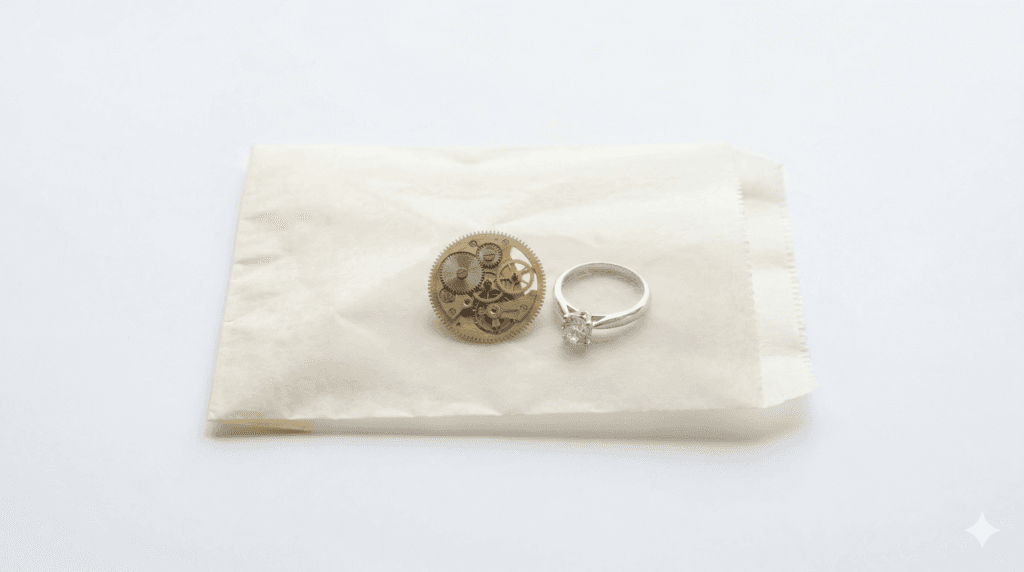
Glassine Bags Packaging: What the Material Actually Is
Glassine is a dense, smooth, translucent paper made from refined pulp and finished by supercalendering. This process produces its characteristic glossy surface. Plain glassine, waxed paper, silicone-coated release liner and heat-sealable coated paper are different specifications: ask which construction is being quoted.
Evaluate these five characteristics when selecting a glassine bag:
Semi-transparency: The dense fiber structure allows light transmission — contents can be partially seen without opening the bag, combining protection with visibility.
Smooth surface: Glassine can help separate surfaces during handling. It is not a guarantee of zero scratches or zero particles; test the actual bag with your product, especially for polished or optical surfaces.
Grease resistance: Performance depends on grade and exposure conditions. Plain glassine is not waterproof and should not be specified as a controlled water-vapour barrier without relevant test data.
Chemical suitability: Do not assume that every glassine grade is acid-free, archival or safe for sensitive direct contact. Request the relevant material specification and test evidence.
End-of-life options: Confirm the complete bag construction, including coatings, adhesives and printing, and check acceptance with the receiving recycler. A claim for base paper does not automatically apply to every converted bag.
What Is a Glassine Bag?
A glassine bag is a pouch or envelope made from glassine paper. Flat, gusseted and adhesive-closure formats suit different loading processes. Its smooth surface and partial visibility can be useful for retail inner packaging and selected industrial interleaving applications after sample testing.
Glassine bags are available in:
- Flat envelope format — open top or fold-and-tuck closure, standard for industrial interleaving and component packaging
- Self-seal adhesive closure — for fast sealing without tools, suitable for high-throughput packaging
- Gusseted bags — expanded side panels for thicker components or bulkier contents
- Custom printed — glassine accepts printing well for branding and product identification
Key Properties That Make Glassine Bags Useful
Surface Protection Requires Testing
The smooth finish can reduce direct item-to-item contact, but surface cleanliness, pressure and movement during transport also affect scratching. Compare candidate papers with the actual part and inspect for abrasion, dust and residue after a packing and handling trial.
Not Automatically ESD-Safe
Do not treat ordinary glassine as qualified anti-static or static-shielding packaging. For ESD-sensitive items, specify tested packaging appropriate to the handling environment. The EOS/ESD Association packaging guidance distinguishes low-charging and conductive/dissipative materials from the additional discharge shielding needed outside an ESD protected area.
Long-Term Storage Needs a Separate Specification
Appearance and a generic acid-free claim do not establish long-term compatibility. For photographs, the Library of Congress advises against glassine enclosures. Choose photo-safe storage materials and follow preservation guidance instead of treating packaging glassine as an archival solution.
Semi-Transparent Visibility
The partial visibility through glassine bags simplifies incoming inspection and inventory management — contents can be identified without opening the bag, reducing handling and contamination risk.
Check Recycling Acceptance
Recycling depends on the specific material and the available collection system. Coatings change the assessment; for example, Ahlstrom describes different recycling results for different silicone-coated liner constructions. This does not certify Mavis bags: request evidence for the actual supplied grade and confirm local acceptance.
Industrial and Electronics Applications
Precision Component Interleaving
Glassine sheets or bags can separate lightweight parts and reduce direct contact. Check load, edges, cleanliness and handling conditions before approving a sample. Add cushioning or a more robust outer pack where impact or puncture is a risk.
Electronics Component Packaging
Use glassine only where a product-specific assessment confirms adequate surface protection. ESD-sensitive components require qualified ESD packaging; moisture-sensitive components require a defined moisture-barrier and dry-packing process. Glassine alone should not substitute for either.
Pharmaceutical and Medical Component Packaging
Do not assume a general-purpose glassine bag is suitable for pharmaceutical contact, medical-device packaging or sterile-barrier use. Those applications require application-specific material, cleanliness and packaging validation.
Label Release Liner
Glassine is also used as a base paper for release liners. These commonly receive a silicone coating to control adhesive release; an ordinary uncoated bag is not equivalent to a qualified label liner. Ahlstrom describes glassine release papers designed for silicone coating.
Premium Retail and E-commerce Packaging
For suitable jewellery, fashion accessories and other dry retail goods, glassine can offer a translucent paper-based inner pack. Check closure strength and transport protection. Confirm the full construction before making plastic-free, recyclable or compostable claims.
Archival and Museum Storage
Packaging glassine should not be promoted as a universal archival enclosure. For valuable photographs, documents or artwork, follow collection-specific conservation advice and use materials demonstrated to be compatible with the item.
Glassine Bags vs Plastic Poly Bags
For buyers currently using clear plastic poly bags who are evaluating glassine as an alternative:
| Property | Glassine Bags | Plastic Poly Bags |
|---|---|---|
| Transparency | Semi-transparent | Fully transparent |
| Surface | Smooth; verify surface compatibility | Depends on film and surface treatment |
| ESD protection | Not qualified by material name alone | Ordinary film is not qualified ESD packaging |
| Long-term compatibility | Grade and application dependent | Resin, additives and application dependent |
| Moisture barrier | Not a specified moisture barrier | Depends on resin, thickness and seal; request WVTR data |
| Recyclability | Verify construction and local acceptance | Verify local film collection acceptance |
| Compostability claims | Require evidence for the complete bag | Require evidence for the specified material |
| Waste classification | Check full composition and local rules | Check full composition and local rules |
| Custom printing | Yes | Yes |
When glassine bags are the correct choice over poly bags:
- Sample trials confirm the required surface cleanliness and protection
- The application does not rely on the bag for ESD protection
- The specified paper grade is compatible with the product and storage period
- A paper-based option is preferred and the complete construction meets the agreed requirements
- Premium visual presentation is important
When poly bags remain the correct choice:
- A tested film construction meets the required moisture-barrier performance
- Full transparency is essential
- Cost is the primary specification criteria for short-term use
Glassine Bags vs Kraft Paper Bags
| Property | Glassine Bags | Kraft Paper Bags |
|---|---|---|
| Surface smoothness | Very smooth, glossy | Fibrous, rough |
| Surface compatibility | Test with actual product | Test with actual product |
| Transparency | Semi-transparent | Opaque |
| Grease resistance | Good | Limited |
| Chemical compatibility | Grade dependent | Grade dependent |
| Strength | Depends on GSM, construction and seams | Depends on GSM, construction and seams |
| Cost | Compare quotations for the same specification | Compare quotations for the same specification |
| Recyclability | Confirm grade and collection acceptance | Confirm grade and collection acceptance |
Consider glassine bags when: A smooth, translucent paper inner pack fits the application. Consider kraft bags when: An opaque paper pack is preferred. Compare samples for load, puncture, closure and surface protection rather than choosing by material name alone.
Glassine Bag Buyer Checklist
Before approving production, provide the item dimensions and weight, usable internal bag size, closure style, packing speed and expected storage conditions. Ask the supplier to identify the paper grade, GSM, coatings, adhesive and printing. Agree on sample checks for seam strength, fit, abrasion, dust and closure reliability. For critical uses, define the test method and acceptance criteria before ordering.
Browse our glassine paper bag range to discuss suitable formats. If your application needs moisture or electrostatic protection, start with our aluminum foil and ESD bag range and specify the required tested performance. For an overview of the distinction, see our anti-static packaging guide.
Are glassine bags waterproof?
No. Glassine is moisture-resistant for light contact — it resists grease and light surface moisture — but is not waterproof. For products requiring full moisture barrier protection, specify aluminum foil composite bags or laminated moisture barrier bags instead.
Can glassine bags be heat-sealed?
Standard uncoated glassine cannot be heat-sealed. For heat-sealable glassine bags, a PE or other sealable coating is applied to the inner surface. Specify heat-sealable grade if your packaging line uses heat sealers.
Are glassine bags anti-static?
Not automatically. Ordinary glassine should not be relied on for ESD protection without appropriate test evidence. Specify qualified low-charging and conductive or dissipative packaging, with discharge shielding where required by the handling environment.
What GSM is available for glassine bags?
Available GSM depends on the grade and bag construction. Ask for the current specification and a sample; select basis weight using the product weight, dimensions, edges and packing method rather than a generic GSM range.
Can glassine bags be custom printed?
Yes. Glassine accepts flexographic and screen printing well. Custom sizing, printing, and closure formats are available. Small batch orders welcome.
Contact Mavis for glassine bag specifications and custom sizing: mavisv.com/contact