
Introduction
Every year, electronics manufacturers lose millions of dollars to a silent, invisible threat — electrostatic discharge (ESD). A static charge as small as 100 volts, completely unfelt by a human hand, is enough to permanently damage a sensitive microchip or circuit board. The solution is straightforward: anti-static packaging.
Anti-static packaging refers to any packaging material specifically designed to prevent the buildup or transfer of electrostatic charges that could damage sensitive electronic components during storage, handling, or shipping. For manufacturers, distributors, and procurement managers in Southeast Asia’s fast-growing electronics sector, understanding and choosing the right ESD packaging is not optional — it is a fundamental quality requirement.
This guide explains everything you need to know: what anti-static packaging is, how it works, the main types available, the international standards involved, and how to choose the right solution for your products.
What Is Electrostatic Discharge (ESD) and Why Does It Damage Electronics?
Electrostatic discharge occurs when two objects with different electrical charges come into contact or close proximity, causing a sudden transfer of electricity. In everyday life, this is the small shock you feel after walking across a carpet and touching a metal doorknob.
For electronics, the consequences are far more serious. Modern electronic components — including semiconductors, PCBs, integrated circuits, and sensors — operate at voltages between 1.5V and 5V. An uncontrolled ESD event can release hundreds or even thousands of volts in a fraction of a second, instantly destroying microscopic circuits or causing latent damage that only appears as product failure weeks later in the field.
Common sources of electrostatic charge in a packaging or shipping environment include:
- Human handling (walking, touching, sliding components)
- Non-conductive plastic bags and packaging materials
- Foam padding (standard foam can generate significant static)
- Low-humidity environments, which dramatically increase static buildup
- Machinery and conveyor systems
This is why standard plastic bags and general packaging materials are completely unsuitable for electronics. Without proper ESD protection, every shipment is a risk.
How Anti-Static Packaging Works
Anti-static packaging works through one or more of the following mechanisms:
1. Static Dissipation Dissipative materials allow electrostatic charges to flow slowly and safely to ground, preventing sudden discharge. The surface resistance of dissipative materials typically falls between 10⁴ and 10¹¹ ohms, as defined by IEC 61340-5-3.
2. Electrostatic Shielding Shielding packaging — such as metallized aluminum foil composite bags — creates a Faraday cage effect around the contents. This prevents external electrostatic fields from penetrating the package and reaching the components inside. According to IEC 61340-5-3, shielding bags must limit the energy inside the bag to less than 20 nanojoules when tested under standard conditions.
3. Static Prevention (Anti-Static Coating) Some packaging materials are treated with anti-static coatings or additives that prevent charge buildup on the surface of the material itself. Pink anti-static polyethylene foam and bags are a common example.
Understanding these three mechanisms helps buyers select the correct product for their specific protection needs.
Types of Anti-Static Packaging
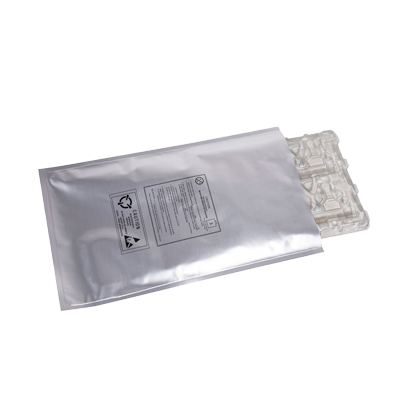
1. Aluminum Foil Composite Bags (Metalized Shielding Bags)
Aluminum foil composite bags are the most widely used ESD packaging solution for high-value electronic components. They consist of multiple laminated layers — typically an outer polyester film, a middle aluminum foil layer, and an inner anti-static polyethylene film.
Key properties:
- Excellent electrostatic shielding (Faraday cage effect)
- Moisture barrier (important for humidity-sensitive components)
- Protection against light and oxygen
- Available in heat-seal, zip-lock, and custom configurations
Best for: PCBs, semiconductors, ICs, hard drives, sensors, and any component requiring both ESD and moisture protection.
2. Anti-Static Bubble Bags (ESD Bubble Wrap Bags)
Anti-static bubble bags combine the cushioning protection of traditional bubble wrap with anti-static properties. The bubble film is made from anti-static polyethylene, preventing charge buildup while absorbing physical shock during transit.
Key properties:
- Physical cushioning + static protection in one solution
- Lightweight, reducing shipping costs
- Available in pink anti-static or metalized shielding versions
Best for: Fragile electronic components, PCBs, optical equipment, and products requiring cushioning during international shipment.
3. Kraft Paper Packaging (Non-ESD Industrial Packaging)
For industrial products that require robust physical protection rather than ESD shielding, kraft paper packaging offers a paper-based option. Kraft paper packaging is increasingly demanded by buyers in Southeast Asia and Europe as sustainability regulations tighten.
Key properties:
- Paper-based outer layer (recyclability depends on any laminated film and local collection)
- High tear and burst resistance
- Available in standard and bubble-laminated versions
Best for: Non-ESD-sensitive industrial parts, hardware, mechanical components, and products exported to eco-regulation markets.
4. Anti-Static Kraft Paper Packaging
A specialized category that combines kraft paper with an anti-static treatment or liner. This solution is growing in popularity as manufacturers face simultaneous pressure to reduce plastic use while maintaining ESD protection.
Best for: Lightly sensitive components where full Faraday cage shielding is not required, but static buildup must be prevented.
International Standards for Anti-Static Packaging
ESD packaging is specified within a wider ESD control framework, so it helps to know which standard covers what. Two standards cover the ESD control program in a facility, and one covers the packaging itself:
IEC 61340-5-1 (International Standard)
Developed by the International Electrotechnical Commission, IEC 61340-5-1 defines the requirements for an ESD control program — grounding, protected areas, personnel, and how packaging is specified within the program. It applies to the organization running the program, not to an individual bag. It is widely used in Asia, Europe, and the Middle East, making it especially relevant for electronics manufacturers in Vietnam, Thailand, Malaysia, Singapore, and Indonesia.
ANSI/ESD S20.20 (American Standard)
Developed by the ESD Association (ESDA), this is the North American counterpart to IEC 61340-5-1. The two program standards are closely aligned — useful for manufacturers supplying both Asian and US markets. Like IEC 61340-5-1, it applies to a facility’s ESD control program, not to packaging products.
IEC 61340-5-3 (Packaging-Specific Standard)
This sub-standard specifically addresses ESD protective packaging properties. It defines classification categories, test methods, and performance limits for materials used to protect ESD-sensitive devices through all phases of production, transport, and storage. ANSI/ESD S541 is the ESD Association’s counterpart for packaging.
When evaluating a supplier, ask for:
- Test reports confirming surface resistance values
- Shielding test data for shielding bags (measured per IEC 61340-4-8 or ANSI/ESD STM11.31)
- Material Safety Data Sheets (MSDS) if required for customs
How to Choose the Right Anti-Static Packaging
Use this decision guide to identify the correct packaging type for your application:
| Requirement | Recommended Packaging |
|---|---|
| Full ESD shielding + moisture barrier | Aluminum foil composite shielding bag |
| ESD protection + physical cushioning | Anti-static bubble bag |
| Non-ESD-sensitive parts, paper-based option | Kraft paper packaging / bubble kraft |
| Light ESD protection, paper-based option | Anti-static kraft paper bag |
| High-volume SMD components (tape & reel) | Custom moisture barrier bags |
Additional factors to consider:
- Climate: Southeast Asia’s high humidity can accelerate corrosion of exposed components. Metalized bags with moisture barriers are strongly recommended for components stored or shipped within the region.
- Component sensitivity: Check your component manufacturer’s datasheet for ESD sensitivity class (Class 0, 1, 2, or 3A per JEDEC/IEC standards). Higher sensitivity requires stronger shielding.
- Destination-market rules: Some markets, such as Vietnam and the EU, run packaging EPR schemes that require material information. Confirm what your customer needs before shipping.
- Volume and MOQ: Custom-sized bags reduce material waste and optimize packing efficiency for high-volume production runs.
Frequently Asked Questions
What is the difference between anti-static and ESD shielding packaging?
Anti-static packaging prevents charge buildup on the surface of the material itself, but does not shield the contents from external electrostatic fields. ESD shielding packaging (such as metalized aluminum foil bags) creates a conductive layer that forms a Faraday cage, blocking external fields from reaching the components inside. For sensitive semiconductors and ICs, shielding bags are the recommended choice.
Can I use regular plastic bags for electronic components?
No. Standard polyethylene plastic bags are highly insulative, meaning they actively generate and hold static charges. Using them to store or ship ESD-sensitive components creates a significant risk of damage. Always use packaging specifically designed and tested for ESD protection.
What surface resistance should anti-static packaging have?
According to IEC 61340-5-3, conductive packaging materials should have a surface resistance below 10⁴ ohms, while dissipative materials fall between 10⁴ and 10¹¹ ohms. Materials with surface resistance above 10¹¹ ohms are classified as insulative and provide no ESD protection.
How do I verify that my packaging supplier meets ESD standards?
Request third-party test reports confirming surface resistance measurements, decay time testing, and shielding effectiveness (for metalized bags). Reputable suppliers should be able to provide documentation referencing IEC 61340-5-3 or ANSI/ESD S541 test methods.
Is kraft paper packaging suitable for electronics?
Standard kraft paper is not anti-static and is not suitable for ESD-sensitive electronics. However, anti-static treated kraft paper is available and appropriate for components with lower ESD sensitivity classifications. For high-value semiconductors or ICs, aluminum foil composite bags remain the recommended standard.
What packaging is best for shipping electronics within Southeast Asia?
Given Southeast Asia’s tropical climate — high temperature and humidity — we recommend aluminum foil composite bags with heat-seal closures for any moisture-sensitive or ESD-sensitive components. For physically fragile items, anti-static bubble bags provide added cushioning protection suited to the regional logistics environment.
Conclusion
Anti-static packaging is not simply a regulatory checkbox — it is a direct line of defense against product failures, warranty claims, and supply chain losses. Choosing the right ESD packaging means understanding your component’s sensitivity, your shipping environment, and the compliance standards required by your customers.
Whether you need aluminum foil composite shielding bags for semiconductor shipments, anti-static bubble bags for fragile PCB assemblies, or kraft paper packaging for non-ESD industrial parts, the right packaging partner makes all the difference.
Mavis Packing produces aluminum foil composite and ESD shielding bags on our own foil-bag line in Suzhou, and supplies anti-static bubble bags and kraft paper packaging through our manufacturing partners, to manufacturers and distributors across Southeast Asia. Specification sheets are available on request. Contact us for samples, custom sizing, and bulk pricing.