Introduction
Every bubble mailers buyers guide eventually comes down to the same question: which mailer protects the product, fits the parcel rate, and looks acceptable on a customer's doorstep without turning into a separate cost center? The choice looks simple from the outside, but for distributors and e-commerce operators across Southeast Asia, choosing between a poly bubble mailer and a kraft bubble mailer can be the difference between the lowest unit cost and packaging that meets the destination market's recyclability expectations. Pick the wrong format and the savings on the bag can be lost in damaged returns.
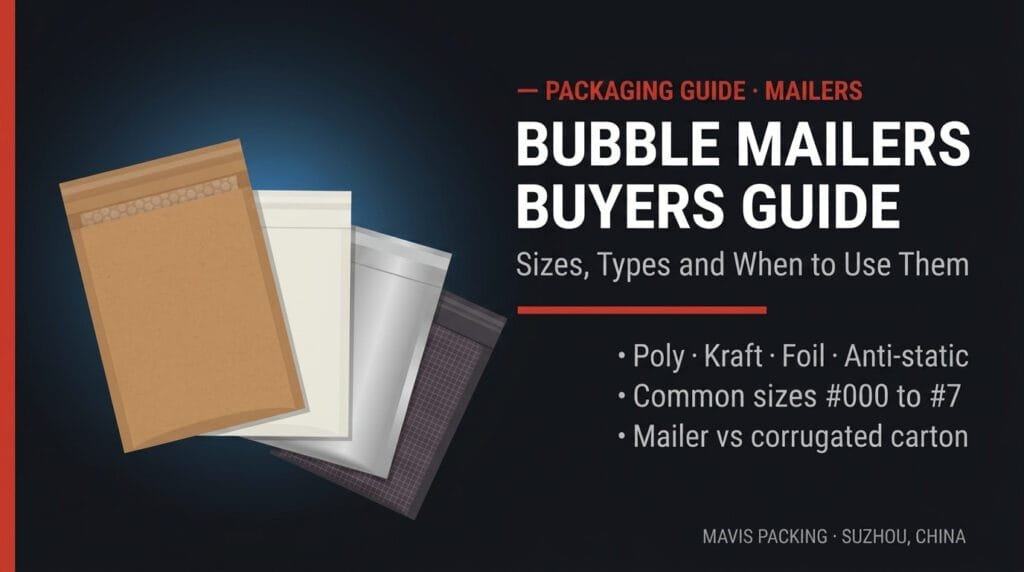
This guide walks through what a bubble mailer actually is, the four main types in commercial use, how size codes work and why they are not universal, and the decision rule for when a bubble mailer is the right format versus when a small corrugated carton makes more sense. For a deeper view on kraft bubble formats specifically, the kraft bubble bags vs bubble wrap comparison sits underneath this article as the focused follow-up.
What Is a Bubble Mailer
A bubble mailer is a flat padded envelope built from two layers: an outer skin (plastic film or paper) and an inner bonded layer of air-bubble cushioning film. The two layers are sealed at the edges to form a flexible parcel that protects light goods against impact, abrasion and short-drop shock during shipping. Most mailers have a peel-and-seal adhesive strip at the opening, resist tearing, and are lighter than a corrugated carton, which can move a parcel into a cheaper postal rate band.
The construction sounds trivial, but four things vary across formats: the outer material (poly versus kraft), the bubble size and layer count (single or double bubble), any inner functional layer (aluminum foil, anti-static treatment), and the closure style (self-seal strip, gummed flap, or zipper). Those four variables produce the entire commercial bubble mailer range.
The Four Main Types of Bubble Mailer
1. Poly Bubble Mailer
An outer skin of LDPE or co-extruded poly film bonded to an inner bubble layer. The lowest-cost option per unit, water-resistant out of the box, and available in white, black, metallic, and full-color printed finishes. Poly bubble mailers are common in domestic e-commerce because they handle rain well and tear cleanly on opening. Their weakness is end-of-life: curbside paper streams do not accept them, and EU extended producer responsibility (EPR) schemes increasingly charge higher fees for hard-to-recycle plastic packaging.
2. Kraft Bubble Mailer
An outer skin of unbleached or bleached kraft paper bonded to an inner cushioning layer — either plastic bubble film or a paper-based cushion such as embossed or honeycomb kraft. Kraft mailers carry a visible environmental signal at unboxing and take crisp print for branding. Recyclability depends on the inner layer: all-paper constructions can go into paper recycling, while kraft with a plastic bubble inner is a mixed material that usually needs the film separated first. Kraft bubble mailers cost slightly more per unit than poly. The kraft paper bubble packaging guide covers industrial-scale use of the same construction.
3. Aluminum Foil Bubble Mailer
A bubble mailer with an aluminum foil or metallized film layer laminated into the outer skin. The metallic layer adds a moisture-vapor barrier, some thermal insulation, and light blocking, which helps with humidity-sensitive goods and short temperature-sensitive shipments. It is not a substitute for a validated cold-chain package. For the deeper logic on moisture barrier choices, see the article on moisture-proof packaging for electronics.
4. Anti-static Bubble Mailer
A poly bubble mailer made with anti-static or dissipative additives in the outer film and the bubble layer. Surface resistance typically falls in the dissipative range (roughly 104–1011 Ω), so the mailer is designed to limit the static charge that a standard bubble mailer can build up during handling and opening. It is used for shipping bare boards, sensor modules, and replacement parts — our anti-static bubble bag is a typical construction. Anti-static bubble mailers are not the same as aluminum foil shielding bags and do not provide Faraday shielding; they reduce charge generation rather than block external discharge. The complete guide to anti-static packaging explains the difference in more detail.
Common Sizes and How to Read Them
Bubble mailer size codes are not universal. North American suppliers use a numbered system (#000 to #7), UK and European suppliers use letter codes (A/000 to K/7) with different dimensions, and many Asian factories simply quote inner width × length in millimeters. Whatever the code, the number to specify is the usable inner dimension, not the outer cut size, because the seal flap and side seals reduce the usable space.
For reference, the common North American numbered sizes are listed below. Dimensions are nominal inside sizes; usable space varies slightly by manufacturer, so always confirm against the supplier's size chart.
| Size | Inside (inches) | Inside (approx. mm) | Typical contents |
|---|---|---|---|
| #000 | 4 × 8 | 102 × 203 | Jewelry, SIM cards, small accessories |
| #00 | 5 × 10 | 127 × 254 | Cosmetics samples, USB drives |
| #0 | 6 × 10 | 152 × 254 | Phone cases, small electronics accessories |
| #1 | 7.25 × 12 | 184 × 305 | Paperback books, small apparel |
| #2 | 8.5 × 12 | 216 × 305 | Folded T-shirts, notebooks |
| #3 | 8.5 × 14.5 | 216 × 368 | Documents, folded apparel |
| #4 | 9.5 × 14.5 | 241 × 368 | A4 / letter documents, tablets |
| #5 | 10.5 × 16 | 267 × 406 | 13-inch laptops, larger apparel |
| #6 | 12.5 × 19 | 318 × 483 | 15-inch laptops, multi-item kits |
| #7 | 14.25 × 20 | 362 × 508 | Bulky soft goods |
Custom sizes are common for volume orders. The most frequent sourcing mistake is ordering the next size down to save money and then forcing operators to crease products into the bag, which damages corners and encourages over-taping of the seal flap.
When to Use a Bubble Mailer (and When Not To)
A bubble mailer is the right format when the product is flat or near-flat, light (typically under 1 kg), and tolerates a short drop. Apparel, small electronics, cosmetics, books, accessories, and replacement parts all fit. The mailer is the wrong format when the product has fragile corners, an unprotected screen, or dense components that concentrate impact force on one area, and it becomes increasingly risky as weight approaches 2 kg. At that point a small corrugated carton with internal bubble film or honeycomb fill is usually the safer choice, because the mailer's flat geometry concentrates handling shock at the corners rather than spreading it.
Decision Matrix
| Scenario | Recommended Mailer |
|---|---|
| Domestic e-commerce, soft goods, low cost | Poly bubble mailer |
| Destinations with strict recyclability expectations | All-paper kraft mailer |
| D2C brand unboxing, premium feel | Printed kraft bubble mailer |
| Humidity-sensitive goods or short temperature-sensitive shipments | Aluminum foil bubble mailer |
| Replacement boards and ESD-sensitive parts | Anti-static bubble mailer (plus a shielding bag for highly sensitive parts) |
| Heavy or fragile-corner products | Small corrugated carton with internal bubble |
| Rainy-season ground delivery | Poly or foil bubble mailer |
Common Mistakes When Sourcing Bubble Mailers
- Sizing by outer dimension. Always specify the usable inner dimension; the seal flap and side seals can take 25–40 mm off the outer cut and hide the actual product space.
- Ignoring the destination market's recycling expectations. Poly mailers do not go into paper recycling; all-paper kraft mailers can. For a multi-market exporter the simplest rule is to qualify both formats and choose by destination, not by domestic preference.
- Treating anti-static as marketing fluff. A poly bubble mailer without a dissipative additive can build up a significant static charge on opening. For electronics shipments this is a real defect risk, even if the part is also inside a separate bag.
- Skipping the test ship. A new mailer format should always go through a dummy shipment cycle before it replaces a working incumbent. The cost of one test shipment is far smaller than the cost of one rejected B2B return.
- Buying without a print spec. Printed mailers reinforce the brand at delivery. If volume justifies it, a one-color print is often worth costing against plain stock mailers.
Frequently Asked Questions
Are bubble mailers waterproof?
Poly and foil bubble mailers are water-resistant by construction — light rain and damp transit will not normally penetrate them. Kraft bubble mailers resist light splashes, but the kraft outer can absorb moisture if soaked. For monsoon-season ground delivery, specify a poly or foil mailer, or a kraft mailer with a moisture-resistant coating.
Can bubble mailers be recycled?
Kraft mailers with a paper cushioning layer (embossed or honeycomb kraft) are generally accepted in paper recycling. Kraft mailers with a plastic bubble inner need the film separated before paper recycling. Poly bubble mailers are usually accepted only in soft-plastic collection schemes where these exist, not in curbside paper streams. Local rules vary, so check the destination market's guidance.
What is the difference between a bubble mailer and a padded envelope?
A bubble mailer uses an air-bubble cushion layer. A padded envelope is the broader category and can be padded with bubble film, paper fiber, honeycomb kraft, or foam. Bubble mailers are the most common form of padded envelope in commercial shipping, but paper-padded envelopes are increasingly used where plastic-free packaging is required.
What weight can a bubble mailer carry?
Most bubble mailers are used for parcels up to about 1–2 kg. Above 1 kg, consider a double-bubble construction (two bubble layers) or a small corrugated carton. The seal-flap adhesive is rarely the failure point — corner stress on heavier parcels is.
What is the MOQ for custom-printed bubble mailers?
MOQ for printed mailers depends on the material, size, and number of print colors. Send us the size, print design, and quantity, and we will confirm the MOQ and lead time with the quotation. Specification sheets are available on request.
Conclusion
A working bubble mailers buyers guide does not deliver one universal recommendation; it delivers a method. Match the outer skin to the destination market's recyclability expectation, match the cushion construction to the product's weight and fragility, size by usable inner dimension, and reserve foil and anti-static specifications for the shipments that genuinely need them. The cheapest mailer per unit is rarely the cheapest mailer per delivered parcel — but the right mailer usually is.
Mavis is a one-stop industrial and electronics packaging supplier based in Suzhou, China, serving distributors and manufacturers across Southeast Asia since 2014. We supply poly, kraft, and aluminum foil bubble mailers in common standard sizes and printed formats through our manufacturing partners, alongside our own ESD and aluminum foil bags, kraft paper packaging, and industrial tape. Contact us for samples, custom specifications, and bulk pricing — 24-hour quote response, flexible MOQ.